08 May, 2023

Summarising Child Development initiative of 4 years!

Let me share an article 'The role of parenting in developing communication skills in infants and toddlers- an experience from a Child Development Centre', which I sent to the Developmental Paediatrics Unit at CMC Vellore, for a conference, which was arranged in April, 2023 at Vellore.

I have updated the article, giving some more information on the child development initiatives that ASHIRVAD, Developmental Paediatrics Department at MOSC and the department of Physical Medicine and Rehabilitation of the Bangalore Baptist Hospital, jointly sponsored during the last four years. 

In fact, at the fortieth year of ASHIRVARD, an initiative for Child Development, started in 1983, fostering development of its services in Chennai, Nagpur, Vellore, Pondicherry, Bangalore and Kolenchery, the following narration of the events and experiences of the last four years highlight some of the aspirations we pursued. 

During my morning walk recently, I noticed tender cashew nuts covered with red ants in the cashew tree inner garden. I felt awful. The red ants suck the sap from the pulp of a tender nut, which would have become a full cashew nut in few months. If not sprayed with insecticides, these nuts would have considerably reduced the pulp inside, sometimes leaving them as a shell without any pulp! 


The cashew nuts have to survive this vulnerability!

1 The changed infant nurturing practice

It was while walking back to our cottage after sighting the cashew nuts covered with ants, some thoughts about the vulnerability of an infant in the  changing circumstances, in which they grow up now, dawned on me. For most part of my childhood and later years, till the technology revolution invaded the homes from the nineteen eighties, with the use of the colour TV, computer, internet, later the Mobile phone, iPads, etc, parenting was an interactive process between infants and parents.  The parenting process of a new born was at the centre of a family’s daily rhythm. Now infants and toddlers have to adapt to the priorities parents choose for themselves. Now in the words of Dr Susan George, while referring to the technology invasion in our home capturing the pre-school children, wrote: 'Their bodies are with us but their mids are sold'!

I remember how parents used to sing to their children, tell stories, read stories from picture books,  play with them with balls made of paper or coconut palm leaves, go to a nearby stream to play in the water, play in the sand, make clay models, etc,. Even when I was training to be a paediatrician in the seventies, it was common for parents to give reasonable attention to promote communicative habits in infants and toddlers by engaging them in play.

Just as the red ants invade and harm the tender cashew nuts, the overuse of mobile phones, TV, internet and iPads distract and impair the normal development of language, communication and social skills of  pre-school children! The machine interface has replaced the normal physiological human interface between infants or toddlers and their parents. 

2. A challenge to  Infant’s processing skills

The auditory system of an infant is conditioned to recognise human voice from few weeks  after birth. The visual cortical system enables an infant to recognise the mother's face by about three months and develop a reciprocal smile with a familiar person by four to six months. The human voice, facial appearance, the feel of the person who often carries the infant, his or her odour, the touch and strokes on the face and hands or rituals during bath time, feeding time or while or changing the napkins create a sense of familiarity and curiosity in an infant. 

An infant, who babbles or makes jargons sounds in the latter half of the first year, as early imitations of regular sounds heard at home, goes on to express variety of sounds, syllables and words before the first birthday. An infant wants to communicate and reciprocate as he or she grows up in an environment of words, gestures, actions, pictures, singing, etc. Being in such an environment increases the communication instinct of an infant. 

Now about seventy percent of pre-school children, who come to the Child Development Centre, where I work now, are brought by their parents, for not having shown the proficiency of language development expected at two or three years. The history of many infants is that,  from the time of starting the weaning food at six months,  they were introduced to the visual screen of TV or Mobile phone, where they watched advertisements, cartoons or other entertainments for four to six hours during the day. Some of them slept late and developed fragmented sleep due to the over-activation of their visual and auditory systems. Since most mothers, if they work outside home, return to work after six months of the maternity leave, the breast feeding got discontinued and a third person would have taken charge of the infant care. This further hampers the development of attachment behaviour between the infant and parents, required as a foundation for developing normal language and communication process.   

The eco-system of the human interface is replaced by the machine interface, which might be  a factor for the current explosive numbers of toddlers brought to Child Development Centres for delay in their language, social skills and behaviour.  Is this a consequence of making the TV or Mobile phone as the 'Third parent' !

3. A change in co-parenting

The machine interface is an invader that displaces infants and toddlers from being attentive to human voices, their faces and interactive communication. Adding to this, if the infant is left without the usual rituals of being sung to (not listening to music from the phone), played with, taken for social contacts with adults and children, or engaged in play at home with toys and household articles, then the delay in the interactive and communication process would get compounded.

The mind set of some parents currently from what I come across, is that the Internet, Mobile phones, cartoons, etc  are good for pre-school children as they would help to develop proficiency in language early. What toddlers do is repeat the machine language in the way they heard in the cartoons, without knowing the meaning or context. They parrot a language which is too early for the brain to process for its semantics, pragmatics and prosody. The colourful screen, animations, movements, stereotypical body movements of the cartoon figures with no semblance to normal human body or appearance or behaviour, freeze an infant or a toddler to a fixation of sight and sound which occupy their mind, displacing the human interactive process they needed to develop for normal communicative intent and content. 

The American Paediatric Association suggested that children below four years watch mobile phones or the TV only when one adult accompanies a child, in order to explain to the toddler what is going on in the screen, that too less than half an hour in a day. It is not ideal to let  children below six months to watch TV programmes on a regular basis. Often infants and toddlers jointly watch the adult TV programmes with their parents, which add to the complicity of the causal pathways for the delay in acquiring the language and social skills.  

4. Adverse influences on child development

We seem to have created an iatrogenic developmental delay of language, communication and social behaviour in infants and toddlers by overexposing them to the visual screen! 

Another dis-service professionals do to the parents is to announce this, as an Autistic Spectrum Disorder, without carefully studying the causal pathway for this developmental delay. Only a few pre-school children might have an unknown cause for the developmental delay. Most of the toddlers were already vulnerable due to hereditary factors, antenatal events or perinatal risk factors, which initiated  their developmental delay. This got compounded by lack of human interface, which if present would have naturally enhanced the neuro-plasticity for some recovery from the developmental delay. 

I feel disturbed by large number of pre-school children showing low values of vitamin D, Iron, Zinc and high levels of IgE, ASO titre, and cholesterol in blood. The premature closure of the coronal sutures observed in seventy percent of pre-school children with communication dysfunction who visit us alarms me. Is it linked to low levels of vitamin D from early infancy! A few publications appeared on this topic from this department.  I have some clarity now from the evidences gathering from 2002, that the Cortical Electrical Dysfunction identifiable in the EEG of about thirty five percent of pre-school children with language and communication disorder or sleep dysfunction might be factor in the causal pathway for  their developmental delay. 

During a pre-school health survey of 540 children in a school we noticed that less than five percent were left handed unlike the normal distribution of ten percent or more of left handedness. This raised the suspicion of enforced change of handedness at home or school. In the pool of pre-school children we welcome with language and communication disorders, about twenty five percent of children had a prominence of their left thumb and great toe, while they use the right hand as the dominant hand or are ambidextrous. In such children a high percentage used the left leg to kick a ball. 

We are now developing a criteria to distinguish between natural left handedness and acquired left handedness due to cerebral insult. The interference with the lateralisation of dominance and its impact  on evolution of language and communication dysfunction that arises out of it is now in an advanced stage of a study in our department. We are shocked how there is consistently low pulse oximetry readings at night in children, who have obstructed nostrils with or without snoring, which have gone unnoticed for a while in many pre-school children. 

Most families do not follow a sound sleep hygiene practices leading to fragmented sleep caused by sleep latency disorder, sleep interruptions and disturbed sleep-wake rhythm. From the time I was involved in setting up a sleep monitoring room with EEG tracing in 2004 for children in the Hall of Residence, at the Developmental Paediatrics Unit at CMC Vellore,  I have pursued the role of sleep dysfunction in behaviour and communication dysfunction since then.  The three studies published from this department on sleep and the benefit of using Melatonin to overcome the sleep related disorders, carry the message of the value of monitoring the sleep behaviour of children at home. We rely on the videos parents take to help us understand the sleep ignition process, sleep duration and sleep related disorders

Let me quote one of the articles to indicate the thought process that evolved in responding to the sleep related challenges in pre-school children. 

International Journal of Contemporary Pediatrics

Thampy M et al. Int J Contemp Pediatr. 2023 Apr;10(4):546-553

http://www.ijpediatrics.com

pISSN 2349-3283 | eISSN 2349-3291

DOI: https://dx.doi.org/10.18203/2349-3291.ijcp20230735

Original Research Article

Megha Thampy1, M. C. Mathew2, Anna Mathew3*, Liya Grace Kurian4, John Michael Raj5

The role of melatonin in regulating sleep wake disorders in children attending the developmental pediatrics outpatient service of a tertiary care hospital in South India

2Department of Developmental Pediatrics and Child Neurology, 3Department of Pharmacology, 4Department of Developmental Pediatrics, 5Department of Biostatistics, 1MOSC Medical College, Kolenchery, Kerala, India

Received: 20 February 2023 Revised: 15 March 2023 Accepted: 16 March 2023

*Correspondence:

Dr. Anna Mathew,
E-mail: mosc.research@gmail.com

Copyright: © the author(s), publisher and licensee Medip Academy. This is an open-access article distributed under the terms of the Creative Commons Attribution Non-Commercial License, which permits unrestricted non-commercial use, distribution, and reproduction in any medium, provided the original work is properly cited.

ABSTRACT

Background: We have observed that 75% of children with neurodevelopmental challenges visiting the Developmental Pediatrics department of this institution have sleep wake disorders. Disturbed sleep has a negative effect on learning and behavior. In this study we assessed the effectiveness of melatonin in improving sleep wake disorders in children with developmental compromise from this south Indian state.

Methods: Children with developmental challenges having sleep wake disorders confirmed by the pediatric insomnia severity index PISI, who were prescribed a daily dose of 3mg of melatonin participated in this prospective, observational, longitudinal study if the parents gave written informed consent. Parents were educated in the practice of sleep hygiene. The sleep disturbance scale for children (SDSC) was used to assess the overall pattern of sleep and six common disorders before and three weeks after starting melatonin.

Results: Based on the PISI scores, 13, 58 and 20 children had mild, moderate and severe insomnia respectively. Melatonin improved sleep latency, increased duration of sleep, decreased night awakenings, crying spells, dreams and daytime drowsiness. There was a significant improvement in the sleep pattern as indicated by better scores in the total SDSC score as well the scores for the six sleep disorders (p<0.001).

Conclusions: Melatonin has a significant role to play in regulating duration and quality of sleep and improving sleep pattern in developmentally challenged children with sleep-wake disorders.

Keywords: Melatonin, Sleep disorders, Neuro-developmental challenge, Sleep-wake rhythm disorders 

5. A fall out of the COVID time restrictions

It is the COVID season which brought this to its current serious situation. All were advised to keep 'social distancing'. But what was needed was to practice ‘physical distancing’ and engage in creative ways of sustaining social communication. The on-line schooling legitimised the prolonged use of the visual screen at home.  The inadequate social vigilance by the professionals, added to the woes of parents struggling to find a way forward to engage their pre-school children, when social restrictions prevailed for over two years.    

The post-COVID season calls for urgent corrective measures and emergency action plan to help toddlers and preschool children, who are currently struggling to catch up in their language, communication and social skills! The therapy centres, offer occupational therapy, speech therapy and behaviour therapy to pre-school children. But more action is needed to offer parenting education to restore communicative and interactive practices at home.

6. Towards restoring healthy parenting practices 

Let me share six exercises of the last two years in the Child Development Centre where I work, which arose out the need to engage parents and professionals to promote a communicative and interactive environment at home and at the pre-schools. 

The first exercise was to invite parents of pre-school children to have a weekly online interaction on co-parenting and define the content of the nurturing behaviour to promote play based engagement with children at home. This involved each parent taking turns to be with their child during a meal time, bath time, play time, bed time, outing time, etc. It was one way of restoring the routines and rituals associated with infant and toddler care, which got dislocated during the COVID season. Some parents who brought feedback gave indications of how they were able to find an alternative way to media over exposure, by introducing new experiences through play. 

The publication below, released in 2021 by ASHIRVAD at the time of the tenth Anniversary of the Developmental Paediatrics Unit at MOOSC Medical College,  is a guide to parents to observe and record the developmental sequences of children in ten domains, and for parents to be keen observers of the developmental path, their children take. This was a step towards making parents primary developmental champions of their pre-school children. There are video links provided in this booklet, which help parents to follow the steps involved in taking, weight, height, mid arm circumference, and observe skills of hearing, and vision. 


The second exercise was to popularise the idea of creating a Child’s Corner and play at home. A child’s corner is a place at home to locate the collection of toys, books, art and craft materials and other visual aids which would engage pre-school children. The Child Development Centre uploaded  videos in the u-tube to propose a design for a child’s corner at home and illustrated how this can make children gravitate towards play and interaction. The traction towards the visual screen could be partially altered when children have an area at home, which reminded them of what they can do with their toys. We have had parents bringing back encouraging reports of how the child’s corner gave an interactive space for parents and children to explore new activities. The link to the videos:

         https://youtub.be/kqdTnSWBvco  and https://youtu.be/1eONrsUbwkA .

The third exercise that we got involved was to create videos of nursery rhymes and action songs, sung by the professionals in the Child Development Centre and upload them in the u-tube. They were sung and acted in a way, that parents watching them would get introduced to the way rhymes and action songs can be used to engage pre-school children to initiate them to sing along and follow the actions. Most young parents we were in touch, got used to screening the rhymes to the pre-school children, while they sang along and joined in  the actions.  The videos we created helped some parents to return to live singing without the video, which captured the attention of children and promoted better interaction. The link to the videos:

 https://www.youtube.com/watch?v=1fMNug5ncyM

            https://youtu.be/1Y2j_e6kZ88                            https://youtu.be/0xG1jJpBi5E

The fourth exercise was to invite all parents who came to the Child Development Centre  to visit the Family Life Centre, which is a room of exhibits of toys, books, papercraft for children  and posters displaying the different stages of child development from infancy to adolescence. This exposure to the canvas of child development was introduced to the parents for them to pause and reflect on what changes they can bring in their parenting style of pre-school children.

Parents were drawn by what they saw and heard from the professional accompanying them to arouse interest in revising the parenting practices. The child development process is often nebulous in the minds of parents. The visual images help parents to develop a perspective to promote child development practices  by proactive steps in parenting.  

The fifth exercise was to create a manual for parents, Accompany your child, a plan for monitoring the developmentally challenged child (1-5 years), which in its 70 pages of parent friendly presentation, give charts describing the developmental domains.  

Parents can observe and record the developmental process of their pre-school child every two months. This manual is being used by some parents for self-monitoring the development of their pre-school child. They carry this with them when they come to visit us and show their recording of the developmental process of their pre-school child in different domains. 

The sixth experience was getting some professionals to meet online weekly for two years, to discuss the issues of child development and clinical pathways to support developmentally challenged children. The physical Medicine and Rehabilitation department of the Bangalore Baptist Hospital under the leadership of Dr Vinita Varghese created the Zoom platform for this during the COVID season. This provided a forum for peer reviewing some of the activities we were promoting to augment the parent-involved and home-based child development plan. 

7. The way Forward 

All Child Development Centres have two cardinal functions. One is to be a resource centre engaged in paving the way for the developmental journey of a child through an individualised action plan. The second is to enable parents to pursue sound parenting practices to make homes formative and educative for child development.  

What pre-school children have lost in the recent years is the normal communicative environment at home. They were denied regular school experience during two academic years due to the COVID restrictions. Now is the time to restore to pre-school children, their regular communicative environment both at home and in the pre-schools. 

Parents and professionals are to be partners in this journey!


M.C.Mathew (text and photo)


A note: All the percentages of different co-morbidities referred to in this article is based on the unpublished data from the department of the Developmental Paediatrics, MOSC Medical College, Kolanchery, Kerala, India. They are preliminary findings of the studies currently going on.  

Acknowledgments: The professionals at the MOSC Child Development Centre, Miriam, Liya, Shalini, Femy and Femine for creating the videos. Shalini composed Accompany your child; Dr Anna Mathew edited it and ASHIRVAD published it. Dr Vinita Varghese of the Baptist Hospital co-ordinated the weekly online professional forum. 


07 May, 2023

Walking the inner path!

I set out one morning recently for a walk carrying the camera, not knowing, which path I would take on that day! What I spotted was a garden on one side of the road. I walked towards that direction and the first three photos are of collections from that roadside garden. 


It was while I was taking the photos of flowers, I remembered Dr Jacob Chacko, a paediatric surgeon working at the Christian Medical College, Vellore, handing over to me a pot of lawn grass in 1997, when I had come to begin the Developmental Paediatrics Unit in partnership with ASHIRVAD at CMC Hospital. That was 25 years ago. I planted that pot of lawn grass all around the house, where the Developmental Paediatrics Unit was located, which became a large lawn in the hospital campus. It was from this lawn, the grass was gathered from to create another 20 or so grass patches in the hospital during the subsequent years. 

That gesture of Dr Jacob Chacko to gift a pot of lawn grass became a metaphor of some significance during the 11 years, when  I worked at CMC Vellore. He gave the grass that he had gathered from his lawn, when the house he was living, needed to be demolished to build a Nursing hostel. As he moved to a flat, he had no space to create a lawn. He preserved the remnant of his lawn in a pot, until he could find a good use for it. 

On one morning, around 8 am, while I was in the front yard of the house where Developmental Paediatrics Unit was located, to water the potted plants before work began, Dr Chacko stopped to greet me and say, 'I have noticed that you are interested in making a garden. Let me give you the lawn grass I had kept at home'! That is how I went to his home and received the grass that evening. 

Dr Mary Antony who was in training in Paediatrics during my time at Vellore,  later moved to work at Kolkata.  She recently went to CMC Vellore to attend a conference organised by the the Developmental Paediatrics Unit. She sent me message, recalling those early days and commenting on the leadership position that the Developmental Paediatrics Unit at CMC emerged in the national scene, during the last 25 years. 

The grass multiplied to make several green patches in the CMC campus, including in the college campus. This Unit over these years trained Paediatricians in the specialty of Developmental Paediatrics, who are in different places in India, reaching out to children with neurodevelopment challenges. 

It was while at this inner journey path, I noticed a restricted entry to a large campus. Only pedestrians could access that path through this entry. 

That  sight reminded me of the opportunity that was offered to me, to be in a position of leadership in an international organisation, while I was half way through my time at CMC Vellore.  I was asked to go for an interview to London with the offer of travel and hospitality. Although for a few days, I entertained that as a possibility, Anna and I discovered that it was not the direction that we were to take. 

I stood at this spot below, thinking of that decision to stay away from that path in life and felt grateful for the inner voice that prompted us to pursue developing the speciality of Developmental Paediatrics in India by being at CMC Vellore. 

Later in the walk, I came to a road which was not visible beyond the bend. Seeing a car passing by on that road assured me that the road had a destination! 


It was while stopping at this spot, the memory of a good friend who used to visit us at Vellore came back to me. He visited us just before he was to go overseas to work. During that conversation, what came upon me was to wish him and his family: 'A journey into the highways of life to find their purpose and direction in life'. About 18 years later, I realise that this family has been able to live their vocation. They found suitable educational environment for their children. They as professionals made significant contributions. They live purposefully mindful of others in need. Their on going connections with people where they used to work earlier, has been an endearing experience for their former colleagues. During the contacts with the family for years before and since their relocation, they gave me an insight of how relocation is the way beyond in some situations. There are times when relocation is needed to redeem life and pursue the larger vocation!

Standing on the roadside with  no visibility beyond the curve, I have had  a refreshing recollection time about instances in our family life. There were times when the path ahead could not be pursued beyond some steps. After I retired from CMC Vellore in 2008, I  meandered for three years, not knowing the path ahead. It was Anna,  who felt that it was good for us to be back in our parent's home, to live as my mother needed care and support with her advancing age. It was while we were here, we sensed an opportunity at MOSC Medical College, to begin a service for neuro-developmentlly challenged children. During the last eleven years that became a path finder for me to have an in-depth perception of disturbed family life, many parents are forced to go through, while attending to the Neuro-developmental needs of their children. 

The photo below of a long path, leading to something beyond which was visible only faintly was another reflection time during this walk. The walk looked promising as the path indicated the direction towards a valley and peek of a mountain. 

The sight of the valley and the peek at the end of the road, as seen in the picture below, became a symbol of some refreshing recollections. 

One recollection was about the season of the last 11 years at my work place. All the developments of the department of Developmental Paediatrics were first time experiences for the institution. It was the first time a tangible effort to develop a support system for developmentally challenged children led to useful services for children and families. It was a peek and valley experience. The peek experiences involved creating different services which brought comfort for children and parents and seemed to change the developmental profile of some children. 

While some good and worthwhile events were taking place, there were also events taking to valley experiences in the recent years, which made work difficult and stressful. I am nearing the end of my time in the work place, feeling grateful and celebrant about the opportunity of the last 11 years, to find a path that I had not envisioned. From being at a position, when the path ahead was hardly visible, the memories of the long and straight path of the last 11 years symbolised in  the photo above, refreshed immensely.  


At  the end of the long walk from where I could have a breathtaking view of the peek and valley as shown in the photo above, I had some more surprises awaiting me on thread side. 

Those surprises were the flowers below on both sides of the road that led to the valley. 


Each of the flowers reminded me stories of pleasant experiences of the last 11 years. Let me  narrate one of the stories . That was symbolised by the floor in the last photo. 

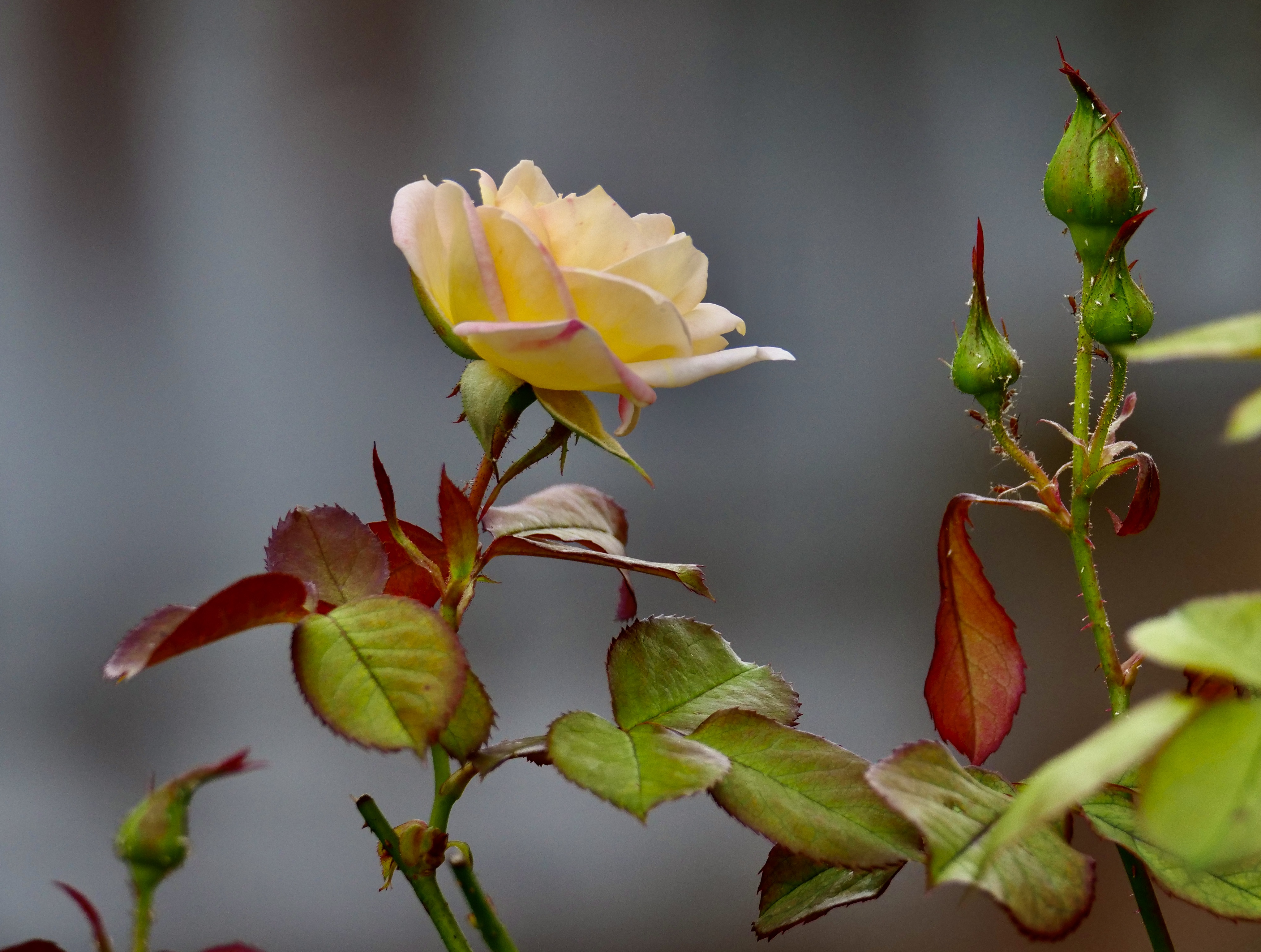
The partially open peach rose flower with an adjoining bud in the background, brought back many memories. During the years at the ASHIRVAD Child Development Centre, Chennai and later at the Developmental Paediatrics at CMC Vellore, Sekar, the support staff used to bring me peach and white rose flowers for the vase in the consultation room.  Sekar did it gladly and faithfully. The flowers began to be integral to developing a perspective on child development. 

The flowers are fresh, fragrant and fragile. 

The three applications that evolved out of proximity to flowers were: To make child development service refreshing; to bring an aroma of goodness and care into the lives of families; to serve children knowing that the developmental needs make children fragile cognitively, behaviourally and socially. 

So coming to view these flowers at the end of that walk, each of them with accompanying buds, reminded me of the prospects children carry with them in their developmental journey! 

Standing there, watching each of these flowers, I felt moved that Anna and I were given an opportunity to pursue this path in our professional journey to be with children, during the last forty years. 

We did not choose to walk this professional path. It was through the arrival and departure of Anita, our daughter, Anna and I were awakened to follow the voice within to find our vocation by being in the company of developmentally challenged children. 

A walk that started as an activity for exercise and sight seeing, ended in an inner journey spread over forty years!

Walk along the inner path regularly. That is what echoes within me now! 


M.C.Mathew(text and photo)


06 May, 2023

The traction to lean to one side!

During my walks, I have been observing how trees grow to their full stature. In this process of their growth, I noticed three phenomenon: One, trees leaning to either side. Second is growing up straight. The third is they spread out in all sides with foliage, flowers or fruits. This got my attention, when this distribution of the growth pattern of trees was common to trees in gardens and on waysides.  

The two trees below had a left or right leaning. In fact the Christa's tree inner garden with its heavy leaning to one side has often  made me wonder about this one sidedness which some trees seem to develop during its growth!


The tree below is tall but the evenness of its branches and foliage is missing. The branches on the right side looked more flourishing with a relative bareness on the left side of the tree. 


What was striking about the trees below is the symmetry and a equidistribution of their branches on all sides with foliage or flowers


During the recent experiences in life, I have had an opportunity to connect these sights with real events in my life. 

I realise that I have a leaning towards a certain perspective, whether it is related to professional life, Biblical view on life, social issues, political ideologies, societal compulsions, art, life style, creature comfort, community life, etc. 

This leaning might have arisen from thought life, which received input which was less than integrated or wholistic or balanced. 

This came to sharp focus through different experiences during the last four years when the pandemic of COVID gave a new glimpse of the vulnerability that humanity suffers from a one sided view of life. 

It is clear that the laboratory in China from which the COVID infection spread to the community globally denies any role for what ever has happened. The inference is that the laboratory had a sinister purpose to dabble with with virus. I leave it for history to tell us more about tit. 

That one event in history shook our very existence and readiness to cope. 

It was during the four years, since the first outbreak of COVID, I noticed leaders of many countries frozen without ides for resources to respond to a health crisis. 

I have been involved in promoting child development for forty years now. One experience that  shakes be to the core is the casualness with which families approach preparation of the home for childhood developmental needs. 

A family who lived and worked overseas had their first child growing up for five years with grandparents, at the end of which, the parents feel devastated to see their child in a 'mess' behaviourally, socially and relationally. 

The one sided view of life of families, to give importance to their work, better income, better life style, more creature comfort, more savings, etc has caused upheaval in their children's  life, resulting in many children struggling with post traumatic experiences.

How has this affected me!

I listen to this story, five of such stories yesterday!  I have felt restless, angry and unsettlement emotionally with no remedial step, that is tangible enough to revive the parental attitude of promoting primacy to children till they crossed the adolescent years. 

Th parenting practices, getting subsumed by the aspirations of parents for their own prosperity and prospects, to me is causing children grow up bereft and accommodated. The home seems to be inclined towards parents and not inclusive of addressing the needs of growin up children.  Otherwise why should a four year child has only less than ten toys and no children's book at home, whose parents are both professionals of high standing! The TV and mobile phone are the substitute parents for that  child!

I have come to feel the pain of this one sidedness in parenting!

What is alarming is the tendency of children in the adolescent years, leaning to their presuppositions and living to go after what make them indulgent and pervasive. Are we about to loose another generation of children, to the lure of of the glamour world of indulgence and self reducing behaviour!

We need a generation of children who are like, what appeared above in the last two photos, flourishing in an all rounded way. Their fullness, contributed by an all compassing care and provision from infancy to adolescent years, is what would make children to be sound in character and integrated as human beings. 

It is this voice of reason,  appeal, and action plan that is missing in the horizon. 

While talking to a presbyter of a Church recently, he told me that he gives counselling to prepare couples for marriage. After fifteen years into this, he feels that it is equally important to initiate a Family Support Programme in every congregation, to help families in their formation, parenting practices and strengthening childhood wellness. I felt gad that he was a feeling person and thinking to evolve an action plan for family formation and sound parenting practices. 

Our children feel the traction to lean towards apparently gratifying ideologies, life style and outlook to life! We need more centering practices to help our children to grow up to be rounded in thought, conduct and behaviour !

Otherwise we would end up frozen,  without a sound action plan,  pushing children to live leaning towards the fantasy, the glamorous world offers them!

M.C.Mathew (text and photo)

05 May, 2023

A conversation with Myself!

This road side sign above, in the Highways and busy streets invited my attention recently! I looked for such sights in different places and I realised that they are often located in curves, traffic junctions  and hair pin bends on the road. They are conspicuous on hilly roads. 

What caught my attention was this road sign on the hight way, where the road is straight with full visibility for long distance, but warning the driver of a traffic junction ahead.

It became a metaphor for me during a  long distance ride recently. 

I thought of the last two years in my life. I spent about ten hours at work, six days in a week while responding to recover from the dull of the COVID season. The result was 'driving' fast along  the highway of life. I realised, how time for everything else, which was my normal rhythm, was subsumed by the demands at work place. I found that this 'fast highway drive' was beginning to show signs of emotional tiredness and inner restlessness. 

On that evening, after returning from the long distance ride, I felt like walking along the pedestrian path of a busy road. 


The above foot path with elegant trees, casting shadow on the path on one side and with rows of houses on the other side, called back my earlier thoughts, while riding on the high way. This walk was a slow, easy and full of sights to take in. 

There were gardens in the courtyards of houses with lawns and flowering plants. Even a small space was alive with sights that captivated my attention. The thoughts about speedy high way drive of the last two years at work place, and the reduced living, deprived me of other colourful experiences of life, returned to me. A friend recently sent me a message, 'Hi, MC, your regular messages stopped coming! Are you well'!

My life got so preoccupied with work related engagements that the colourful experiences of friendships, regular morning walks, time  to read, visiting places and being in touch with friends got reduced to the extent that the void of these experiences was beginning to make me feel restless.

It was a way of living I was forced into or to be fair, which I chose, which was making me to feel distant from the inwardness that I was used to. The inwardness is an experience when one lives in an integrated way holding the wide range of experiences in life in good balance without any one dimension displacing others. 

During this walk along the foot path, I saw a sign board into a wooded area. I took that path as I was in a reflective mood. While walking along the wooded area in the narrow footpath, I heard the bird calls, felt the wind blowing, watched the bird movements and sensed that it was a cooler and quieter space, different form the noisy high way. I had no idea where the path would rejoin the footpath of the road. I knew that I could retrace my steps if the path did not join the footpath on the main road. 


What was ahead me was the view of the other side of the the sub-urban area. That was a panaromic view of  the next suburb. It was a breathtaking view, well beyond my imagination. 

While taking in this sight, I felt drawn to the canvas of life within, when so much happened in the last two years, which remained unnoticed or unattended as I was speeding along the high way. 

The text on the first photo in this blog came back to me, 'Reduced Speed'! 


While walking back about two kilometres, after this inner awakening to visit the inner canvas of my life, I felt aroused within to sense, feel and listen to the voices that did not have space within earlier for a while. My preoccupied self got another wind of insight that life is for living fully now and not wait for  a later occasion. 

The now in life had become far form me! 

I longed to have the rhythm of life returned to me with a sense of presence to myself!

At work place while I was closing the day at 7 pm yesterday, this imagery of living the  rhythm of life fully, returned to me. 

One comment of a parent helped me to long even more for that to be a present reality in my life. He said: 'Thank you for giving me time even though it was late in the evening'. He had waited for three hours for this time to arrive for his consultation. I asked him how he spent the time while waiting. He told me: 'I took that time to go over the last two weeks of my life experiences'!

I felt blessed by that comment. Here was a person, who used his time to gauge if he needed to reduce the speed!

Life is a canvas of experiences, peeks and valleys. It is when we live connected with our inward events, we become alive to process the events of each day with meaning and coherence!

It is when use live connected with ourselves, God of our lives would become more experiential!


M.C.Mathew(text and photo)

04 May, 2023

Distinct features and Differences


I had a helpful conversation recently with a friend, who helped me to develop better observational skills in spotting and identifying birds. The picture above is that of a Grey Butcherbird, which I often got confused with the pictures below of an Australian Magpie. As both birds are native to Australia, it was easy to stay confused.


I realised from that  conversation that some birds are native to some countries or regions and not migratory by habit. The plumage is a distinct feature of each bird species and needs to be observed carefully to get some clues for species identification. The size, differences between a male and female bird, feeding and nesting habits are other distinguishing features. The bird calls are so distinct that if one can record it and compare with the bird calls of similar looking birds, it is almost conclusive of the species of a bird. 

I have an interest in bird spotting not so much for for identifying the species, but for  getting a glimpse of their behaviour. The Grey Butcher bird is a shy bird where as an Australian Magpie is most comfortable to be in public places where there are movements of people and vehicles. 

I listen to the stories of children through this optic. All children have a character of a distinct behaviour. When families describe how different their children are from each other, I sometimes find a wishful thinking in parents that, had their children been similar in temperament and behaviour, it would have been easier. 

Let me suggest that this needs to be explored with each family. I found that if a child was born at a time when the family was not ready to welcome that child, families have found adjustments more difficult. 

I have recently enquired from about fifty families whether they chose the timing of the birth of their child. Only 15 percent of families did say affirmatively, which means that most women would not have had a health check up and taken due health care planning before conception . It is not common that women check on vitamin D status or thyroid status or blood sugar and blood pressure  parameters before they decide on the timing of conception. I wish this practice would change as supplementation with vitamin D or Folic acid if the mother is older in age would have a salutary effect on foetal development. 

I have been struggling for the last five years, to get an insight into the impact of maternal pregnancy related stress factors on foetal development and infant behaviour. I have enough reasons to think that maternal adverse health related factors affecting physical, mental and emotional health have a bearing on the evolution of the behaviour of the infants, toddlers and even pre-school children. 

I feel appalled that in some situations husbands and wives are temporarily located in two different places during the pregnancy period. This itself adds to the emotional stress, more so if the woman is experiencing the first pregnancy. 

Birds are wired to behave differently. So also are children!

But there are several factors in the behaviour of parents, which have a direct impact on the formation of the behaviour of their children. This is documented in the science of epi-genetic. Our children inherit genetically lot of their behaviour, but they acquire many behavioural features by the conditioning effect of  the home environment. 

The science of Child Development invites all parents-to-be, to get insights about the role of parenting in optimising the child development process! Those who are already parents, let me suggest that the sconce of Child Development is often subsumed in the cultural and traditional practices! This needs to be reset, for which parents and professionals ought to collaborate. A home is a place, where parents and and children co-habit with larger opportunities and space, created for children, as the window into the future of children is designed by parental participation in childhood formation. 

Let me invite parents to free themselves from the shackles of some traditions which restrict children from the full unfolding of their development! The 'authoritarian' role men play at home reducing women to be 'followers' instead of being partners is a disturbing sight for me. There cannot be a place for patriarchal or matriarchal control in the affairs of home, instead husband and wife functioning to serve each other. In that interface children are born and develop imbibing a loving domestic ambience, where a husband and wife live longing for each other's wellness. Till a husband repositions himself in a serving role and a wife discovers her role of bringing wellness to her husband and children, a family has not evolved into a home of mutuality and self giving!

If only the husbands and wives can be living together through the full time of pregnancy, parents-to be would have promoted a sound entry into parenting readiness!

If all parents, till their children are older, till around 8 years, decide to be together as much as possible, they would provide stability to the childhood formation!


M.C.Mathew(text and photo)


03 May, 2023

Moving in the fullness of Time!

Anna and I noticed these two Lorakeet birds perched at the mouth of the hollow of a bifurcated tree trunk, while on a walk during our holiday. We noticed their body postures suggestive of readiness to move to another flight station. 


In  a short while, one flew away while the other looked sullen! Soon it recovered and composed itself to fly away probably in the direction of its partner. 


About fifteen minutes later, we noticed two Lorakeets feeding from a dry legume! I have a strong suspicion that they were the same Lorakeets we spotted earlier in our walk. 


This becomes a metaphor as we look into our lives. 

Anna and I worked for ten years in an institution, from where Anna retired first and I am still continuing. 

The movement of the Lorakeets hesitantly initially, I suspect, resulted in finding the reward of finding  feed. 

It was the movement which made that possible. 

This makes me wonder whether my time too has come to move on from where I have been involved for 11 years!

Movements are not for better prospects, but to find more content in ding less, but what is significant and critical at the transition stage of life. 

Both Anna and I are in the transition from active full time professional work to doing what we can do voluntarily, which is one aspect of the intent of retiring to be selective in engagement!

The movement is a process to find a new horizon and depth in life!

A transition time is a time of experiencing sauced inner movements to prepare for leaving to receive a new calling. 

I look forward to  the coming few months to sense the timing of the movement and the direction to which we feel moved!

A stanza of hymn, 'I the Lord of sea and sky', ;published pin 1981, came to my mind while I received these thoughts in my mind:

'I, the Lord of wind and flame,
I will tend the poor and lame.
I will set a feast for them.
My hand will save.
Finest bread I will provide.
Till their hearts be satisfied.
I will give my life to them.
Whom shall I send?'

There is a call within a calling!

Let me hear and find the direction!


M.C.Mathew(text and photo)