Showing posts with label Life. Show all posts

08 October, 2023

Between the cup and lip!


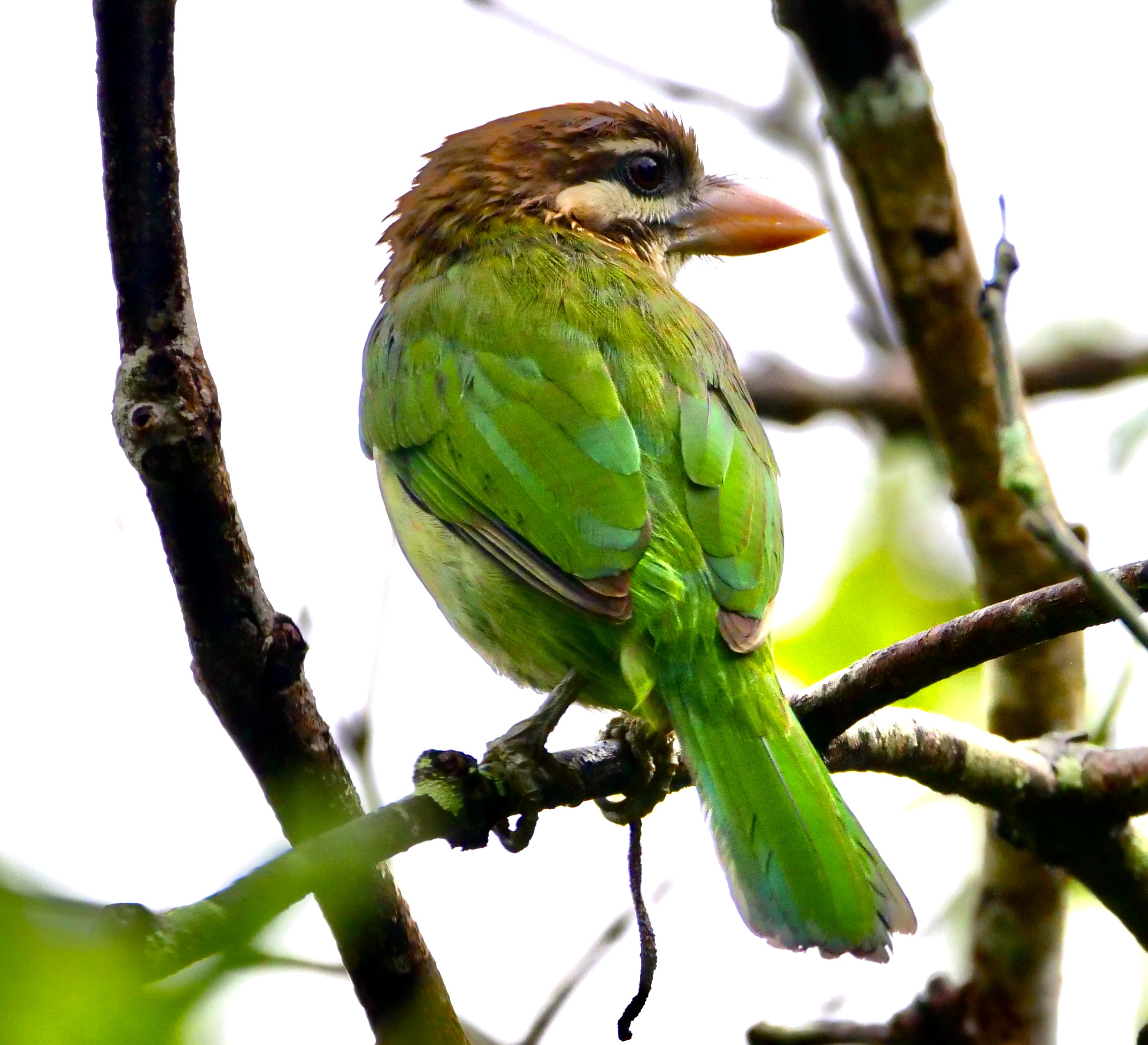
A garden is a theatre of creative activities. One such engaging scene caught my attention while on the morning watch for bird movements. The Barbets start the day in our garden with a visit to the tree with ripe berries. 

On this occasion the bunch of ripe berries was hanging on the terminal part of a slender long branch. Any weight placed on the branch would cause it to droop and and with movements of Barbet to reach the berries, the branch moved up and down. That movement made it difficult for the Barbet to accurately bite the berries between its beaks.

After a few failed attempts, it managed to pluck one, while being unsteady on a moving branch. I watched this carefully planned persevering movements, till the Barbet got initially just a bit of the pulp, and later the whole berry. Before it flew away after its meal, the Barbet gave away a bird call. That bird call gave me an indication of its mindfulness for its family of birds. Most avians have such a fraternal behaviour, although they also have an instinct to preserve themselves first. 

Another Barbet perched in the nutmeg tree close by, flew to the berry tree, probably hearing the Barbet's bid call. It looked around, and suddenly flew and returned with a mouthful of berries. That barbet was more experienced to fetch its food. It was such a quick move that I could not capture the sequences in the camera. It was like a trapeze artist in a circus, who lets go of his swing and flies to the opposite side to be captured by the other swinging trapeze artist! All in an ultrashort time!


Usually the parents of six month old baby, when they offer the weaning foods, feed the baby as the hand-mouth co-ordination is only evolving to carry the food from the plate to the mouth. But between nine months and one year, most babies start practicing self feeding, although the child would need some assistance. They start their journey to feed themselves in incremental steps, till by two to three years, most children are able to feed themselves fully. 

This journey between the 'cup and lip' is a solitary journey. The longer a child is fed, as it is done now days, while making the child watch the TV, the longer is the time a child would need to develop the skills for self feeding. 

The builder who worked on our broken wall in the last two days, and  restored it, had a moving story about his long journey into being an independent wall builder over about eight years. 


He started as a helper to carry stones to the building site and mix cement with sand to make the binder. Later it was his job to hand over each stone to the mason. Then he progressed to use some implements like hammer to make the granite stone into a fitting shape, to align with other stones. Subsequently he picked up the skills to plan for the gradient of the wall, while building upwards. The last step was to learn the art of building the foundation. This whole process he said was tedious and and demanding. The masons he worked with were harsh and a few of them would not share any information and kept some professional secrets to themselves. One mason with whom he worked was an enthusiast to teach skills to others. 

For him now, the journey from the cup to the lip was long and tiring. Now with thirty years of experience behind him,  he uses is skills well to hep those who assist him to learn. 

I received an invitation yesterday for a conference,  which is organised by a professional, who helped me to organise an international conference, twenty five years ago. From being a professional working in the department, this person moved on to get more qualified and begin a specialty in a prestigious medical school in India. Seeing this person rise to this level of leadership and acceptance brought much joy and contentment. That person had a long journey, to be able to be in this responsible position in the speciality. 

Another former colleague is forging in to a new specialty of counselling and is taking the first step to get formally trained. This interest in family counselling arose from the first hand experience in being involved with families who needed accompaniment. This too will be along journey for that person. 

As I spend most of the day in the quiet room below, since retirement in June 2023, which was our former garage, I am surrounded by photographs of memories of people, places and events of the last forty years, since Anna and I moved into  Child Development pursuit forty years ago. 


I recall many who contributed immensely in our journey to foster a response to the needs of developmentally challenged children in few places in India. To those, who helped us to travel between the 'cup and lip', let me present our tributes of gratefulness with fruits from our garden, which we and the Barbets relish!


Each of the significant experiences, which formed our lives had a gestational period, to give us a sense of how they would be formative!

All of us continue journeying forward, remembering that the latter years are often more blessed than the former years.

M.C .Mathew (text and Photo)

01 October, 2023

Towards the inward!


I love watching this movement of the Honey Bees towards the inward of a flower where it finds its nectar! On the days when the petals are wet with water drops, they move from the periphery towards the centre of the flower, from where it can gather its feed ! They may hover over the flower before it reaches the inward part of the flower. 

The inward journey of humans is an experience that most people seek after. The religious and spiritual rituals and routines most people follow symbolise the longing for this inward journey. 

Some people by strictly following all the traditions and rituals such as going to worship places, having prayer times at home, celebrating festivals and other special occasions associated with the religious icon they believe in, are on this inward journey. They find encouragement, comfort and fulfilment. And yet, a question remains in them: is this all that is in this religious journey. 

Some others get consumed by the idea of service while searching for the inward journey through all the traditions and rituals. They give importance to attend to care for others and stay engaged in doing good from which they find consolation and fulfilment. They too have the question, 'Is this all in spiritual journey'!

There are some others who go on a personal inward journey apart from doing what others would do as mentioned above. 

In the Book, The Alchemist , Paulo Coelho, tells tells the story of an Andalusian shepherd boy, Santiago, who  travelled from his homeland Spain to the Egyptian pyramids in search of a treasure buried in pyramids. Whenever he slept near a sycamore tree in an abandoned church, he would see a dream of this treasure. He got this dream repeatedly and was told to look for his treasure in the pyramids by a Gypsy woman and Melchizedek. He sold his flock and set off for this journey. He worked with a crystal merchant for a while, during which both Santiago and the and the merchant became wealthy. Santiago cashed his earnings to pursue his personal legend and joined a caravan crossing the Sahara desert. 

Santiago met an English man in the caravan, who being an alchemist, educated him into the secret of alchemy, the Elixir of lIfe, the Emerald tablet, the Philosopher's Stone, each with with its own significance. The caravan stopped its journey to avoid being trapped in the conflict taking between two tribes. There Santiago fell love with Fatima and  agreed to marry her after finding the treasure he was looking for. Santiago met a scholarly alchemist who having heard about the story of his dreams of a treasure, encouraged Santiago to leave Fatima and the caravan to continue his journey to the pyramids.

While the alchemist  and Santiago continued, Santiago was stolen of his money and narrowly escaped being captured by soldiers. Santiago escaped a storm and reached the other side travelling with the alchemist. On reaching the Coptic monastery, the alchemist left him. Two men seeing him dig the ground to look for his treasure thrashed him. 

Following this one of the men advised him about the worthlessness of dreams and pursing them. This man shared his own personal dream of seeing a treasure buried under a sycamore tree near a dilapidated church in Spain. The description of the place was the place when Santiago had his dream about the treasure hidden. He returned there and found a chest of jewels and gold buried under the tree. 

After this Santiago planned to return to Al-Fayoum, where he would want to unite with Fatima. 

This novel is a metaphor of a persuasive message, that there is a treasure within each of us, which we can find, but only with a journey inward traversing through the history of our lives where the eternal truth, God of our lives, has made His presence known to us through our life experiences.  Our life experiences are meant to be the journey path to find our dream of 'knowing God and being known of God'.

For me, life is an experience of this journey inward, where, by demystifying the experiences of peeks and valleys of life, find the silent presence of God. God's presence in our inner lives and the consciousness of it, are discoveries most people make by taking a journey inward. 

The Honey bees moved beyond the water drops. They were not satisfied by finding the water drops.   

Santiago's story is a vivid narration of how a person can have a dream and go after it. What Santiago encountered in that journey was a spectrum of experiences of hardship, loss, friendships, courtship and the discovery of treasure. 

The treasure that Santiago set out to find was was actually beside him. He needed his experiences and a person to finally lead him to the treasure. 

It is the inward journey that leads us to experience the presence of God. Often we continue the inward journey after detours and missed paths. The times of loosing the way and finding it again is normal for most of us in this voyage inward.

The bees moved towards the nectar; we move inward to find the treasure within us! 

M.C.Mathew (text and photo)

24 September, 2023

September visitors


The above were birds, were the common visitors, in our garden in September 2013. They came regularly to their flight stations as a routine or for seeking feed. 

They have their familiar locations and arrive and leave around the same time in the mornings. 

The month of September was a rainy month, with most mornings cloudy and cold. That did not stop them from beginning their day following the routine. 

I noticed that their body did not appear wet even during the rain. Their feathered body has the ability to dispel water instead of absorbing water and soak the feathers. Even when they are soaked, they shake their body and disperse water to dry their body for flight movements.

The feathery coat is their thermal blanket. They attend to keep their coat as their protection. 

The contour of the body and the differently structured and distributed feathers serve them well, whether for flight or for thermal regulation. 

They value their life, live flying and learn to fend for themselves. The avian behaviour is worth studying, to get a sense of the mission in life. 

Jesus of Nazareth was a good friend of some fisher men and chose some of them to be with Him to become His close companions.  I often wondered how they became the people, that  Jesus desired for them to be!  

I came across a passage in Luke's gospel chapter 5 verse 2, which gave me an insight about fishermen and their routines. Jesus 'saw two boats  lying at the edge of the lake, but the fishermen had gotten out of them and were washing their nets'. 

For fishermen, there were three essentials to relate to each day. Their boat, net and sea. 

In the statement above, the fishermen had left their boats at the edge of the lake. That was the place of safety for their boat, till they set out fishing next time. They ensured the safety of their boat. Having watched fishermen at the beach close by to our home, I remembered how fishermen inspected their boat after unloading the fish caught, and applied protective layer of oil on the outside the boat to keep it waterproof. They do a detailed check up of their boat once in two weeks. 

They attended and mended their nets after each fishing trip. Sometimes, we can see the fishermen taking time to examine each portion of the net and mend it to secure it. They do this on the shore. The net is their provider. It catches the fish for them, for which they keep the net ready. 

It was during such times, the fishermen experienced the 'slow time', which in the words of Sue Stuart-smith, in her book, 'The well gardened mind' is 'entering into a living relationship with the present'. The slow time 'is not doing things more slowly'. Quoting from Carl Jung, the author proposed that, 'At times, I feel as if I am spread out over the landscape and inside things, and myself living in  every tree, in the splashing of waves, in the clouds and the animals that come and go, in the procession of seasons'. The sense of awareness or mindfulness is a gift that we can give to ourselves, when we get engaged in different activities,  to grow in the sense of presence. 

I suspect that the fishermen were such people. That is why Jesus of Nazareth could use several illustrations of things seen and experienced around them as truths, which could be spoken in a parable style. The injured man in the Good Samaritan story is one such story, emphasising the neighbourliness that we are to carry with us towards others in need. 

Jesus of Nazareth needed His followers to carry a heightened sense of awareness about themselves and their neighbours. 

The third in the triad of daily experience of the fishermen was  the sea. In the passage referred to here, it is mentioned that they returned from the fishing expedition without catching any fish (v 5). This is beyond the domain of the fishermen. They would get a good catch or none at all! Their livelihood was based on what they caught. There was a daily insecurity that they lived with. They got used to the varying experiences of having plenty as well as the denial of the daily provision. 

The fishermen could take care of their boats and nets. But they were subject to the unknown situations in the sea and the outcome of the fishing trip. 

I presume that Jesus of Nazareth would have been fascinated by the responsible behaviour of the fishermen on the domains that they could be in control and living with hope pertaining to the domains outside their control. 

Life has two realities. 

In our daily living, one reality is that, lot is in our charge and domain. It is in as much as we are able to be stewards in the domains that are in our control, we live with a sense of responsibility. 

The birds that I referred to could keep their body, dry, oiled and groomed. They could not control the wind or the weather! By keeping  their feathers dry and well groomed, they protect themselves from the adverse impact of the wind and weather. 

The fishermen by keeping their boat and net ready to use, ensued their voyage into the sea to become purposeful. 

A parent told me recently, that in her desire to introduce some routines to her six years old son, she was grooming him to  accept responsibility. He would lay the table and help in clearing the table. He could polish his shoes. He unloads the washing machine and spreads the clothes on the line to dry. He attempts to keep the Child's Corner tidy and user friendly. In introducing these tasks, he according to the mother, is learning to be attentive to the needs of others at home. What a commendable way of introducing a child to be conscious of the home and its environment!

This lady went on to share something about her husband in an admirable way. It is he who polishes their son's shoes after supper while she reads to their son in preparation for bed time. During this time her husband would iron the clothes of their son and of her and  her husband, to be ready for the next day. He would then take their dog for a short walk before its bed time. By the time this routine is over it is usually 9 pm, when both of them have a reading time from a book, and a prayer time with Scripture reading. 

As most of the preparations to begin the next day were attended to in the evening, the mornings were not rushed. On some days the family had time for playing Caroms for a short time, before their son left for the school by bus at 7. 30am. 

This story of this family amazed me about the calling of living they practice! They did not surrender the the demands of the day, but weaved a fabric of order, around the chores which they had to attend to each day.  

The other reality in our life is the unknowns of each day. 

I travelled back in the memory lane to recollect the events of the last three weeks, in preparation to write this narrative. 

I slipped and fell, injuring my nose with a small fracture of the nasal bridge. There was a disturbing event in the family, which plunged us into grief. The facility that I was involved in creating for child development,  in the hospital where I worked until recently, was getting dismantled to create another focus. There were leaks from the roof in our 70 years old cottage during rain,  which needed immediate attention. I narrowly escaped loosing control of the car, I was driving, when one front tyre burst. 

The above negative things surfaced as if, they alone mattered in the last three weeks. I wanted to go beyond this one sidedness of my recollection. 

That was when I recalled a longer list of pleasant surprises. A taxi driver whom we know for a while, brought food for an evening meal in order to share the joy of a happy event in his family. The wood cutter came to trim all the trees in the campus, for which a respite of rain was needed. The domestic helpers worked collaboratively to make the barn free of bugs,  which multiplied during the rainy season.  The quiet room where I spend most of the day needed a coat of paint, which was attended to. Two friends called to enquire about Anna and me and offered to visit us. One friend remembering a greeting card I gave after I retired from CMC Vellore in 2019, sent message appreciating that gesture after 14 years. A friend who is looking for an opportunity to study further had a promising response. 

The above is about living the calling, experiencing the events in life as formative and enlarging in nature!

The followers of Jesus of Nazareth were called to be 'with him'.  They were habituated to be responsible for the domains in their control- keeping their boat and net safe and secure. 

What was beyond their domain was the lake and the outcome of the fishing trip. 

This dimension of learning from their calling  happened when the followers of Jesus responded to His suggestion to cast the net into the lake.  

Living has a dimension beyond what we are habituated to. The edge of the lake, where they berthed the boat and the shore where they sat down to mend the net, were safer places to be in. They were probably resigned to return to their homes on that day with no catch of fish.

The turning point in this lake shore miracle, occurred when Jesus occupied the boat owned by Simon Peter and asked him to move beyond the shore, for Jesus to address the gathering, who had throned on the shore. 

After finishing the address, Jesus of Nazareth, said to Simon, 'Put out  into the deep water and let down the net for a catch'(v 4). They gathered a large catch of fish, so much so, their boats began to sink with the load of fish they caught. Their nets began to break; they needed helpers to gather the fish; they were seized by amazement (Luke. 5: 5-9)

The deep is a place where fish hide. The deep is also a place where there are uncertainties of storm, strong current and risk of drifting. Even in such situation, this event Jesus guiding the disciples to find fish would be an indication of God accompanying us into the journey towards the deep.

Anna and I were in deep trouble, about ten months ago. The intelligence officers from the government of India came to verify the details of the charitable trust that we have been associated with for forty years.  It was the time for the renewal of the permission to continue the activities of the trust for the next five years. They apart from gathering documents and information form us, enquired from two institutions, which the trust supported to create facilities of child development. The custodians of both facilities refused to have had any association with the trust or having received any help, in spite of the documents existing in evidence of that. The intelligence agencies were shocked by the behaviour of the people concerned. The officer took more time to enquire and recommend for the renewal of permission to continue for another five years. Anna and I wondered whether the officers would go by what was told to them in the two places, in which case, we would have been termed to be untruthful. The officers who called me from two offices consoled me and commented us for the good work that we have been involved in. 

We would be drawn into deep situations of stress and trial sometimes. That is the place, where we would encounter surprises and affirmation to continue, as the One who takes us to the deep and intervenes to redeem us, is the God of our lives.  God makes us ready to receive surprises, which is inherent to His nature.  

Those months of waiting in suspense made us anxious. The dishonouring behaviour of friends in the two places where the trust made significant contributions shocked us. Out of the crisis of those months, came an awareness that new experience of the goodness of God in troubled times. When we are made to enter the deep, risk and blessing co-exist. 

Mary, the mother of Jesus of Nazareth before she was married, when received the announcement from an angel that she would, '..conceive in your womb, and bear a son, and you shall name Him Jesus (Luke 1:31), was moved to say, 'Behold the bond slave of the Lord, be it done to me according to your word'(v38)! God would surprise us sometimes by what He plans for us through what seems unnatural ! 

Life is for living and learning. 

We are called to be diligent and responsible in the domains, where we are in control. The call to the 'deep' is worth exploring, because there resides surprises in the domain of God's good purpose for our lives. 

It was while watching the September avian visitors, the thoughts shared above, got assembled into its present state of clarity!

The spectacular sight, in the photo of the Butter cups below,  of the water drops on the petals of the flowers brought a message of hope. The rain drops stayed on the petals.

There is an affinity between water drops and flower petals.  Jesus and His fishermen followers lived in the intimacy of such a relationship.

The fragile flowers received an ornamental appearance with water drops covering the petals. It became a symbol of the grace of God enveloping all those,  who turn to God!


M.C.Mathew(text and photo)


17 September, 2023

Guarding the Lips and Mouth!


I found this Bulbul perched in the Bell fruit tree mostly silent for about fifteen minutes it was perched there. The silence was interrupted by a hushed bird call of short duration interspersed with silence. The hushed bid call was different from the loud, prolonged and sonorous bid call. The bird call had a distinct tune and tone as if it was a self conversation. 

I have noticed this behaviour with with Bulbul birds earlier. I had not thought about it beyond just observing it and leaving it as a habit. 

But this time, I chose to stay watching this till the Bulbul would leave for the next flight station. 

In few minutes, I noticed another Bulbul arriving on the cable, which was about ten feet away from the Bell fruit tree. Every time the Bulbul made the hushed bird call, audible only by heightened attention, the other Bulbul perched in the cable, turned towards the source of the sound. The three photos below show that sequence.  


During the in between time both birds remained silent. This turn taking look in response to the bird call, got me thinking. There was a language of love in that hushed bird call, to which the other Bulbul  responded gesturally. 

Both of them left for the next flight station one after the other. That indicated that there was a reciprocal behaviour emerging between them. 

What stayed with me was the silent periods between the hushed bird calls and the silence of the other Bulbul, except turning towards the bird call. 

The language of love emerged during the period of silence, was expressed in a hushed tone and tune. The other Bulbul prepared itself in silence to respond. The bird call created in silence, borought them together and they flew away together. 

We live in a world of crowded communication strategies. The words we speak get drowned in the multitude of thoughts and ideas we hear. The one who speaks and the one to whom it is spoken are likely to be suffering from listening fatigue. The words spoken do not convey the substance intended or the words heard do not fall in a receptive mind to process to bear fruit. 

A passage in the book of Psalm 141, verses 3 and 4 held my attention. The prayer of David, who was the author of the psalm was: 'Set a guard, O Lord over my mouth; Keep watch over the door of my lips. Do not incline my heart to any evil thing, to practice deeds of wickedness..' 

David, during a self audit of his conversational style, came to this confession that he needed help to attend to what, when and how he could speak. He turned to God asking Him to be watchful over what he would speak. 

We can get a sense of the background for his prayer, when we read verse 4: 'Do not incline my heart to any evil thing, to practice deeds of wickedness with men who do iniquity; and do not let me eat of their delicacies'. He was in a distress over what he heard and how he felt about them.

It is from the stirring of the heart, over stressful or hurting experiences, we speak impulsively and reactively, which in retrospect, add to the fury of the situation instead of bringing comfort or peace. The words spoken once cannot be taken back. An apology would be an act of politeness to express regret, but the listening person has already suffered hurt and an apology does not undo that inner unsettlement. 

It was from silence, God spoke those creating words, which brought in to being, what was in the garden of Eden and beyond. When words are spoken arising out of the silence of the heart, words are creative, restorative and instructive. In fact, words would initiate a healing journey, as it happened with the woman who tremblingly touched the garment of Jesus,  hoping that she would be healed of her bleeding disorder. Jesus of Nazareth knowing that someone had touched Him and healing power had gone forth turned to look and '..seeing her said: Daughter take courage, your faith has made you well' (Matthew 9:22). 

In a chatty society, when words have lost the creative touch, as words do not emerge from the interior silence, we are verbose but not communicating. 

The result of this in the words of Henri Nouwen, a renowned retreat leader and a contemplative is, 'The main function of the word, which is communication, is no longer realised. The word no longer communicates, no longer fosters communion, no longer creates community and therefore no longer gives life. The word no longer offers trustworthy ground on which people can meet each other and build society' (Seeds of Hope p9).

In the case of the Bulbuls referred above, what transpired between them was shared silence and in between bird calls from one of them. The shared silence and the in between bird call seem to have brought communication which meant something to both of them. 

Let me quote from Henri Nouwen from the same book (p10), 'Silence is the home of the word and Silence gives strength and fruitfulness to the word. We can even say, that words are meant to disclose the mystery of the silence from which they come'. 

I find conversations sometimes difficult to relate to. The one who speaks is interrupted by another as he or she is in a hurry to speak or respond. Most speakers speak without regardful of others who are waiting to speak. The pause of silence required between the two speakers is not often practised. The conversations sometimes turn into defence or imposition of an idea without being accommodative of   plurality of ideas on a certain issue. Sometimes the conversations turn into accusation and blaming in an aggressive manner disregardful of how they would affect others. 

The words spoken, if emerging from silence,  can become a light, gift, or a path. On one occasion when I was chairing a governing board meeting, the debate about changing the fees charged for the educational course got prolonged, as most members wanted to express their ideas. Most people wanted the present fees structure to continue which was several times less than what was recommended by the government. The others who wanted to enhance it, although not at the market level, kept pressing for a change of opinion thinking that more discussion would support that idea. The discussion continued although I was about it to bring it to a close. One member got up and said something amusing, but significant to give us a message, 'It is now mid morning break time. We are hungry and thirsty. When we are hypoglycaemic, we need a break and food to think clearly' ! We all laughed and did not need more discussion, even after the mid morning break. 

That was one instance, which I clearly remember,  how prolonging a conversation did not help to come to a consensus; a break or revisiting the issue after some other agenda items are discussed would have been a better option to create another ambience for discussion. 

One practice I  follow in the recent years is to make notes of what a  person speaks in order to keep me attentive. To receive what a person speaks is a way of honouring a person. One set back in many conversations is the we do not speak in a honouring way, even when we  canot consent to the person's opinion. 

It is from the language of the heart we speak. That language when emerging from interior silence, will be graceful. The exhortation we read in Colossians 4:6 is, 'Let your speech always be with grace, seasoned as it were, with salt, so that you may know how you should respond to each person' !

I hope I can share similar reflections form my experiences related to Life, Living and Learning on Sundays!

M.C.Mathew(text and photo)

16 December, 2020

Learning from our Biography


In this sixth conversation, on the theme, Life, Living and Learning, let me explore how we can continue on a personal journey of learning from our biography. 


The personal biography of our lives is a gathering of the history of our birth, growth and transitions in life. The events and experiences form the bulk of that history. The parents nursed, nurtured and accompanied us in our formation. There were relatives, teachers and friends and some others who made us what we are. Our informal and formal learning process gave us foundations upon which we are building our lives now. We have had some major events in our lives- education, career choice, preparation to be a professional, etc. As and when we enter into a marriage relationship, this biography enlarges even more. 


Most of what constitutes our biography are our feelings, responses and interpretations. They are subjective and relational to our mood and perceptions. There is a baggage of emotion associated with these. Psychologists, behavioural therapists, Counsellors and psychiatrists are trained to help us to interpret the story of our past if the past events affect us in a traumatic or disturbing way. The study of dreams is another resource to unravel the mysteries associated with the past events in our lives. In fact, the personal biography is the substance of our being. 


Although our biography is most related to our past, our present is an expression of the past. A fuller appraisal of our past would lead us to a better understanding of the origin of our thought processes, attitudes, values, conduct, actions and reactions. This knowledge of how we have been formed would throw light into the source of our strengths and weaknesses. 


Those of us who have been used to journaling the events and experiences of our lives have a record of events in our lives for easy recollection as and when we want to. Some maintain a journal of dreams at night and take time to reflect on them or seek help to find their meanings. 


It was while talking to a friend, I realized how the decision of his parents to study medicine created so much of a disturbance in his life that it is a weight on his life interfering with his learning process. I observed him to be struggling in his studies contrary to his outstanding performance in his earlier years. I happened to enquire into the reason behind it. For the next one hour, he narrated his woes and regrets for not having been allowed to pursue interest in literature and journalism. There were occasions of outburst of anger. At the end he confessed that it was the first time he talked about it to anyone during the four years in the Medical College. The decision made by his parents seven years back is still haunting and hurting him. 


Our biography can have many memorable experiences which too need recollection because in reliving them we receive new insights that escaped our attention at the time of those experiences. An objective and structured approach to learn from our biography is usually part of a personal development plan, some of us can undertake as part of our preparation for mid-life transition.



Let me explore this under three headings:


1.Revisiting events and experiences

2.Finding a continuum

3.Looking for the larger meaning


1.Revisitng events and Experiences


Our biography of life starts in our mother’s womb, about which the Psalmist has something profound to say: ‘Thou didst form my inward parts; Thou didst weave me in my mother’s womb. I will give thanks to Thee, for I am fearfully and wonderfully made; wonderful are Thy works; And my soul knows it very well’ (Psalm 139:13-14). Our beginning and all events thereafter are under the watchful eyes of the God of our lives. But this consciousness fades away from our mind sometimes when the circumstances of life overwhelm us. 


Our lives get submerged in the events that happen to us. We might get drawn away from a path that we had foreseen for our lives. The circumstances might force us to act in ways that we would not have normally chosen. We might feel being a victim of circumstances. Sometimes we were left with no choice and we felt trapped by the circumstances. Many feel unsettled when the freedom to choose or plan were denied to them. That is how one drifts in life with disappointment, anger and reaction. 


Moses of the Old Testament was one such person. Moses’s mother seeing that he was beautiful, hid him for three months and then left him in a basket in the river Nile (Exod 2:2-3). The daughter of Pharaoh found him and got his mother to nurse him. His mother brought him to Pharaoh’s daughter and handed him over to her when the child grew older. Moses became her son (Exod.2:10). When Moses grew up, he seeing an Egyptian quarrelling with a Hebrew killed the Egyptian and buried him in the sand (v 11-12). When hearing of this Pharaoh wanted to kill Moses. Moses escaped to the land of Midian. 


The turning point in the history of Moses was when he offered to help seven sisters (Exod.2: 16-22) to gather water from the well by drawing water for them to feed their sheep when some shepherds obstructed them. The father of the women, surprised by the kindness of Moses invited Moses to their home for a meal, which subsequently led to Moses staying with them and getting married to Zipporah and having a child (v.22). 


The third chapter of Exodus brings to us an extension of this story with another surprise. Moses while shepherding the flock of his father-in-law, Jethro travelled through wilderness to Horeb, the mountain of God (Exod3:1-5). The wilderness journey was to reach Horeb. 


I want to suggest in a metaphorical sense that it was during the journey through wilderness Moses revisited his childhood. To be abandoned by his parents in river Nile, rescued by an Egyptian woman, nursed by his mother initially and later brought up in the Egyptian traditions, killing an Egyptian arising out of accumulated ‘hate’ of Egyptians for keeping people of his race subdued to extract work from them for the prosperity of Egyptians, fleeing for his life to another land…! Moses’s story was complex, traumatic, long, convoluted, and stormy, till Jethro showed kindness to him, most probably not knowing any of his background. At the end of a journey through a dark tunnel of pain and fear, Moses received welcome and acceptance in Jethro’s house. The walk through the wilderness was an inward journey and not just physical alone. It was during this journey, Moses would have become confessional, honest to himself, and coming face to face with his inner darkness of hate, anger and rebellion. Moses would have felt broken, heavy of heart and repentant in spirit for his violent thoughts and deadly actions. 


It is from this emotional wilderness that Moses reached the mountain of God. What followed was a sight that Moses beheld in utter surprise and reverence. An angel of the lord appeared to hm in a ‘blazing fire from the midst of a bush’ and ‘bush was burning with fire, yet the bush was not consumed (Exod 3:2). Seeing this, Moses said, ‘I must turn aside now and see this marvelous sight, why the bush is not burned up’(v 3). 


Moses went through three transforming experiences. The phrase ‘turn aside’ tells us all about the profound attention Moses was ready to give to make sense of a spectacular sight. He was overseeing the flock, but was willing to leave it aside to pay attention to a significant surprise. A difficult choice indeed! Fortunately, he did not ignore it or set it aside lightly.  


The second was the outcome of Moses’s turning aside to look. ‘When the Lord saw that he turned aside to look, God called him from the midst of the bush and said, ‘Moses, Moses’! What if Moses ignored the sight of the burning bush! It would have perpetuated his state of living in anguish, despair and fear. Some events that happen in our lives, surprises, difficult or pleasant experiences might be ‘calling attention’ experiences, in which God is present with a message and direction. It is only when we stop to pause and ponder, we are taken beyond the present story of our lives in which we are entangled in. 


The Third transforming part of the experiences was, Moses’s response when he heard his name, ‘Here I am’ (v.4). What followed was an instruction, ‘Do not come near, remove your sandals from your feet, for the place on which you are standing is holy ground’ (v.5). Moses was ready to engage the situation, but he was warned to become ready for this encounter experience. Removing the sandal and told not to come close to the presence of God are symbols of preparation needed to be in God’s presence. Moses carried a history of living in the wild and on this occasion when God made His presence known to him to redeem his life, Moses needed a sense of awe, wonder and surrender for which he needed an inner readiness. 


The story of our life is sacred because God has been with us during good and difficult times. The events and experiences can only be revisited to receive the larger meaning if we receive a new optic to look at them. That optic comes to us when we allow the emotions attached to the events and experiences hitherto, get replaced by an objectivity and a willingness to review and receive a new meaning. 


Apostle Peter while in prayer had a vision of a ‘great sheet coming down lowered by four corners to the ground and there were in it all kinds four-footed animals and crawling creatures of the earth and birds of the air. A voice came to him, Arise Peter, kill and eat’ (Acts.1011-14). Peter denied to eat, as he considered them to be unholy, although a voice came to him three times, ‘What God has cleansed consider no longer unholy’(V15). It was after this experience and while Peter was reflecting on the vision, three friends of Cornelius came to look for him to take Peter to meet Cornelius, a Roman centurion to minister to him. Cornelius sent for Peter after he himself had a vision to call for Peter to minister to him. This vision was to help Peter to dissolve his reluctance to welcome non-Jews from becoming followers of Jesus. The friendship between peter and Cornelius was a historic occasion to allow non-Jews to be followers of Jesus. Both of them reviewed their historic racial antagonism towards each other, after they reviewed their past beliefs and practices. 


Our past resides within us and is often a baggage that needs attention. Some of the experiences would emerge to be valuable resources for growth and transition. Some experiences which weigh heavy on us with disappointments or grief would receive a new perspective when we draw near to find meaning out of it.


2. Finding the continuum


Life is not a stand-alone compartments of past, present and future, but a cohesive amalgam of life events. Moses having had an encounter experience with God in the Burning Bush had an experience of  his past  getting subsumed or integrated with his experiences thereafter. Moses was not known for his past after God commissioned Moses by saying, ‘Therefore, come now, and I will send you to Pharaoh so that you may bring My people, the sons of Israel out of Egypt’ (Exod.4:10).


A new beginning of being God’s spokesperson to Pharaoh to lead people out of Egypt! Moses was a new person after his encounter with God in the burning bush. He no longer had to suffer under unsettlement, guilt and shame of his past. God viewed Moses in the light of his readiness to walk in the new path that was set before him. 


I remember meeting with a friend, who was refused a faculty position in the college he studied, due to his suspension from the hostel for having been found in a drunken state during his student days. He told me with a heavy heart, how the college still judged him on the basis of his wrong-doing. He lives a fractured life because of his past. 


We have an example of Zaccheus (Luke.19: 1-10), who was blessed by Jesus in spite of his several acts of commission and omission. Jesus received the confession made by Zaccheus (V8), ‘Behold, Lord half of my possessions I will give to the poor and if I have defrauded anyone anything, I will give back flour times as much’ and helped Zaccheus to move on in his life. We find Jesus releasing Zaccheus from the burden and guilt of the past and leading him into a new mission in his life. 


This is a pointer to how we are to process our biography. Our biography is sometimes heavily leaning towards our past. We behave on the basis of the beliefs we pursue based on the understanding we have from our past. We view a person who offended us on the basis of his wrong doing, rather than be open to receive him in the light of his present perspective to life. We have strong inclinations to keep remembering our past or the past of others for wrong reasons. We live in the present dictated by the impressions of the past. This limits us from moving on to the future which might be altogether promising and transforming.   


When we live with impressions of the past relationships weighing upon us, we are poor collaborators or critical thinkers of opportunities that lie ahead of us. We do not engage an  opportunity to make a difference. I remember how Dr Raj Arole and Mrs Dr Maebel Arole, public health specialists and founders of Jamkhed Public Health Initiative created a new approach by training Village Health Workers to provide primary health care in rural Maharashtra, in the Ahemmednagar district in 1970. It was for the first time such an experiment was done. This model became a way of reaching health care in rural parts which the WHO endorsed and popularised since then. Dr Arole had disappointments while working in a mission hospital immediately after his undergraduate training. He felt disappointed that people lived and died in rural India without being able to access health care. He turned his disappointment in to an opportunity to create a new model and demonstrated how it would work. When the trained women volunteers were able to conduct safe delivery, immunise children, treat diarrhoea with Oral Rehydration Solution, treat Malaria, etc, the health care scenario in rural areas changed dramatically. Dr Arole was able to free himself from conventional approach in health care and leave behind his disappointments about institution centred health care and move on to envision a future of new prospects in rural health care.  


We have a past, which we can turn into a resource to move forward. Or we can hold on to it to influence our thinking and practice negatively. A friend who often talk about his disappointments in his workplace could not use his brilliant clinical leadership to innovative initiatives because he was not able to see others as his collaborators. His solo journey in research took him to new heights, but he was not an effective mentor. Some working with him took longer than five years to complete research toward obtaining a Phd and a few left without completing. His disappointment about not getting an academic leadership in the specialty that he was originally trained, weighed heavily on him even when he was successful in research which brought him recognition.  


That is why the story of the latter years of Moses was most impressive because, he did not remain paralysed because of his traumatic past, but walked the journey that God placed before him. Moses in his engagement with God had a restrained attitude to himself when God was preparing himself to respond to God to lead people out of bondage in Egypt. His response to God initially was: ‘Please, Lord, I have never been eloquent, neither recently nor in time past, nor since Thou has spoken to Thy servant; I am slow of speech and slow of tongue’ (Exod 4:10). God’s response was: ’Who has made man's mouth? or who makes him dumb or deaf or seeing or blind? Is it not I, the Lord. Now, then go, and I even I will be with your mouth, and teach you what you are to say’(v 12). Moses’s response was: ‘Please, Lord now send the message by whomever Thou wilt’ (v13). 


Let me say, that our hesitation to move beyond our own impression or beliefs about ourselves is often so strong, that even when we are given a glimpse of the enabling presence of God who promises us to lead us on, we live as prisoners of our past. God in his favour towards Moses gave Aaron as a companion, although we are told that God’s anger burned against Moses (v14).


Whatever might be our past or our present, that is not the final stage of our lives. We have a present and future apart from our past. What happened in Moses’s life after his encounter with God is worth studying. Moses went back to his father-in-law, Jethro and took his permission to leave Midian and go to Egypt (v18). Moses returned to Egypt from where he ran away earlier, as a starting point to live beyond his past. His resolve to go back to Egypt was a clear indication of the strength he found in God to reconnect with his past but live differently in the future.  His anger that killed an Egyptian was replaced by a vocation to engage Pharaoh and make him ready to let the Hebrews be free from bondage in Egypt. Moses was a changed man at the end of revisiting his past. He received from God a new mission and a new way of engaging it even though the speaking skills that was needed in his new responsibility was not his strength. He and Aaron found each other for this calling! What a difference! An impulsive and aggressive Moses brought into a discipline of working together and leaning on to each other for a new journey with God. 


This is the continuum in life, but living differently with a renewal of vocation and mission!


3. Looking for a larger meaning


Our life is incarnational in nature. We become present in the situations where we are located. We reveal ourselves through our beliefs, practices and relationships. Most of our life experiences are our personal experiences. We share them with others while we live and work in the situations we are located. 


Moses went to Pharaoh and said; ’Thus says the Lord, the God of Israel, Let my people go that they may celebrate a feast to Me in the wilderness’ (Exod.5:1). Pharaoh’s response was, ‘Who is the Lord that I should obey His voice to let Israel go’? (v2). The long, difficult and traumatic engagement with Pharaoh began here. Pharaoh following this made the task for the Hebrews difficult without providing them straw to make bricks, but insisted on the same output (v13). Following this, the Hebrews turned against Moses and Aaron and their words were harsh: ’May the Lord look upon you and judge you, for you have made us odious in Pharaoh’s sight and in the sight of his servants, to put sword in their hands to kill us’ (v21). Moses’s response to God at this juncture is revealing of his dependence on God, as against an impulsive Moses known for his reactive behaviour in the past. ‘O Lord, why hast Thou brought harm to this people? Why didst Thou ever send me? Ever since I came to Pharaoh to speak in Thy name, he has done harm to this people and Thou has not delivered Thy people at all’(v 22, 23). This is the contrast between God’s foresight and Moses’s instant expectation of deliverance. 


When we visit our biography and ponder to find a larger meaning for our existence, mission or relationships, we night find a contrast from our earlier expectations and the actual experiences. Our aspirations or longings were strong enough to push us in one direction. We might find a different path unfolding before us when we revisit our biography. Our disappointments also would have become way marks in our lives to lead us on in directions unknown to us at that time. But those were occasions of turning points in our life. 


In the story of Jesus of Nazareth feeding the five thousand, a boy who had five leaves and two fish had thought of that to be for himself. But when he gave it away to Andrew to hand it over to Jesus, what he saw was his food multiplying to be large enough for many people (John.6:5-14). We celebrate the generosity of the boy who foresaw a larger purpose for his food packet. 


Most of us need surprises or shocking or disturbing events in our lives to see beyond our perception. This is the purpose of revisiting our biography. We need to be freed from our conditioned and restricted view of our prospects, strengths and resources. 


When I gave a paint brush to a child who was four years old with a pallet of colours, what he did surprised me- drawing the sky and the moon. I was amazed that his vision was on the sky. By them he was learning the keyboard, singing tunefully, reading by himself text with good understanding and narrational and descriptive in his conversations. On enquiry I found that he was exceptional in his abilities because both his parents gave attention to foster every interest he showed. The boy did not know how to pursue his interest, but his parents knew. The result was a new world of opportunities opening before him.


It is because of this we need to value the need of companions or mentors who can help us to interpret the hidden story of our lives, which remain dormant in our subconscious level. We need to know some guidelines to demystify our nocturnal dreams. It too is based on some psycho-behavioural premise and perspectives. Our dreams can be metaphorical, archetypical, symbolic or instructional, all of which need demystifying.  


Our life is not just a history or biography but an experience of having been called into being for life abundant. 


The former Cardinal Archbishop of Westminister, Basil Hume in his book, To be a pilgrim, wrote that ‘There are two mountains, Tabor and Calvary. Mount Tabor is the scene of the great Transfiguration, when Peter, James and John found it ‘good to be with the Lord’ (Mat 17;1-13). But we are only able to climb Mount Tabor when we have exercised ourselves climbing that hill which is called Calvary. When our Lord calls us to serve Him, He does not promise an easy way. He calls us to follow Him with courage, with tenacity, in the face of difficulties. The call is unmistakable. Do not be afraid of Calvary. Over that hill you come to another one, a different hill and a friendly one. There you will find a tent you will remain for ever’ (p139-140).


The Calvary and the Tabor experiences in our biography together make our life complete. A journey into our biography is to learn from both the experiences, to lead us for a renewal and restoration of integrated living.


M.C.Mathew (text and photo)