Showing posts with label Infancy. Show all posts

16 May, 2015

A whimper is a call for attention!

With all the chores over, Anna would spend some time almost everyday reading newspapers before her bed time. 

I am amazed at her cheerfulness and conversational fervour even at that time. Her strength comes from her bonding relationships with people. 

Because Anna is away at Ludhiana some medical students came to me to get some help for the research projects they do which Anna supervises normally. During a conversation one  student told me, 'If Anna ma'm was here we would have to ask her just once and she would go all out to help'. It was also a message for me that they have similar expectations from me. 

While Anna is baby sitting now for Amy and Arpit, her desire is that with the first whimper from Ethan, we should sense his need and respond rather than make him cry! The whimper becomes a cry only if the need is not meet. I was surprised to find during my recent visit that she has become familiar with the different whimpers of Ethan. So Anna often discerns his need instantly! Her mother's instinct is alive fully even now!

It is a feeling person who normally can draw near to infants and sense their unspoken need!

M.C.Mathew(text and photo)

04 January, 2013

An infant is an emotional being

Every infant (child below one year) who visits me for consultation leaves me surprised by the mystery of early childhood.

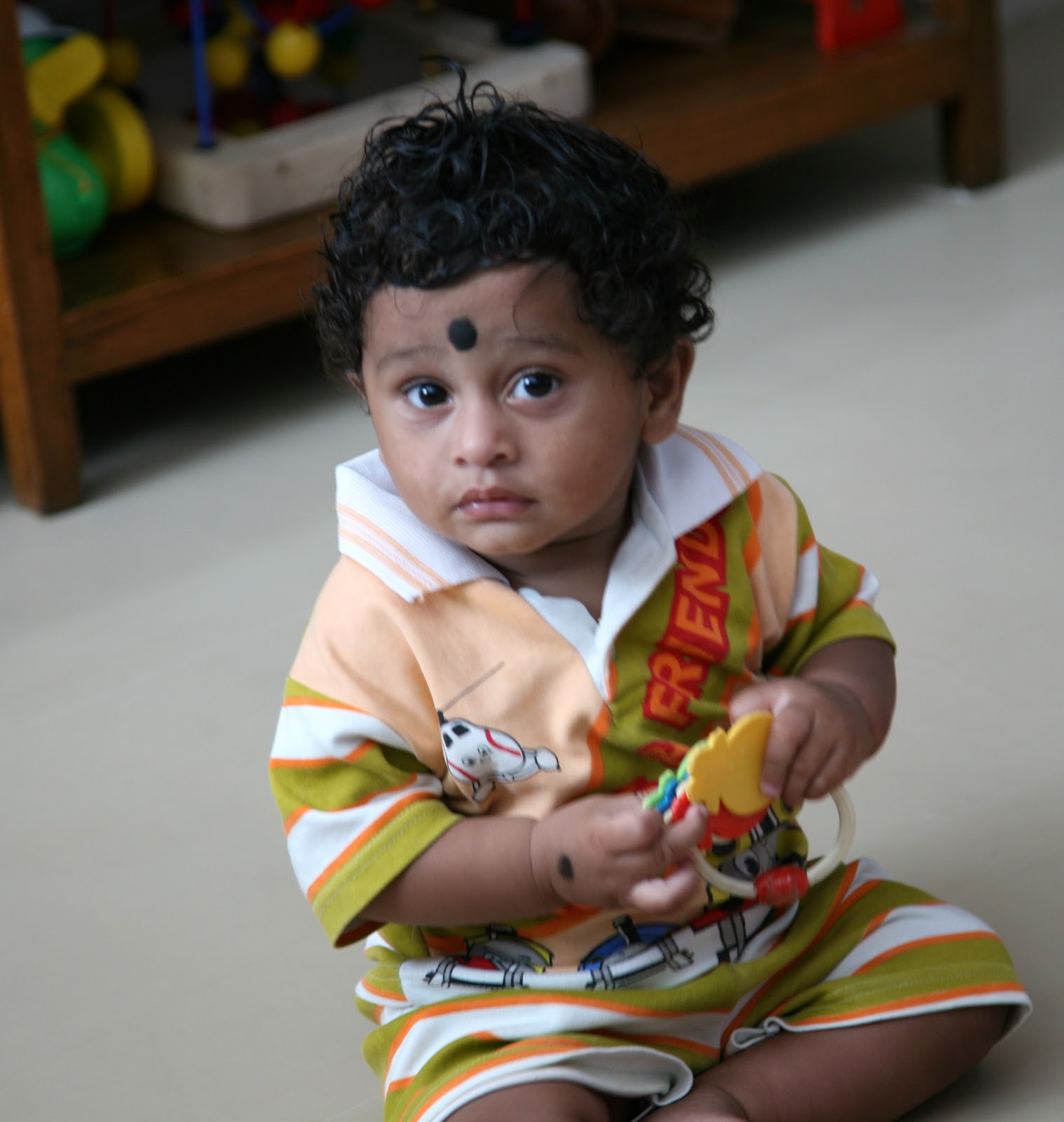
This infant in the photograph is keenly engaged in looking and processing. There is an intensity and curiosity which is explicit on his face. He is attempting to manipulate a toy between his hands, but his attention is elsewhere.

Often people are used to making funny  faces at infants to observe their reaction. Some would stroke or pinch them in the face . Some are in a hurry to carry them. Some would try to wake up the baby if she or he is asleep. There are others who unconsciously frighten the baby by loud laughter or conversations. All these are adult forms of engaging an infant. I am afraid, these are not the ideal ways of approaching an infant.

It is good to pause before an infant giving time and attention for the infant to process the presence of an adult. Three reactions can happen. 

Seeing the presence of a stranger, an infant above the age of four  or five months would cry and turn to the mother to be carried for comfort. If that were to happen, it is good for the adult to wait or avoid any engagement with the infant till he or she returns visual contact.

The second is that the baby is unusually quiet and intently watching the adult initially. The infant may or may not return the smile. Returning a smile is an invitation for the adult to play visually but not to hurry to carry the baby. If the baby were to move the body towards the adult, then alone let the adult offer to carry, that too for a few seconds and return the baby to the mother lest some babies are overcome by strangeness and start crying. 

The third possibility is that a baby from the first instance of contact with the adult exchanges eye contact and takes turns to look. Try playing peek-a-boo and see if the baby is ready for more interactive look and physical proximity. If during the process the infant  reaches out to be carried, please offer to carry. Sometimes even when a baby appears to be visually friendly, the moment you go near to carry, baby may refuse to come to the adult. I wish that adults would honour the desire of the infant and do not insist on carrying the infant. 

Let adults visit an infant knowing that,  the infant may choose to delight or withdraw. It is necessary to respect the fragile and tentative emotional processing of infants. It may be our dress, odour, facial gestures, hair style or voice or  hurried movement to carry that can offset that emotional well being of an infant.

No adult has any right over an infant to carry him or her just because she or he looks cute. Let an infant choose to come to you. Till then stay friendly by reciprocating the eye contact.  Honour the emotional state of an infant. Any trespass of it gives an infant a fearful experience. Let parents recognise this and do let go of the infant till he or she appears comfortable with the adult visitor.

As adults we are under obligation to make every experience of an infant comfortable for him ore her.

M.C.Mathew(text an photo) 

14 October, 2012

A Singing Infant

Anna and I attended the Sunday worship service today in a church, close to our home. It was a recently renovated church with architectural elegance and creative design. It provided  a phenomenal acoustic quality to singing. There was much participation from the laity including women and the ambience was very conducive to worship. We felt inspired and touched by the service and returned home talking about this pleasant discovery of a congregation that we can belong to. 

Let me confess about a distraction that engaged me during the service. It was an infant, resting on his  mother's shoulder, staying silent without a whimper through out the 90 minutes of  the worship service . What was most fascinating was the movement of his head with the rhythm and tune of the music. There were five hymns sung during the service, out of which three of them had a fast beat. His mother was singing loud and hearing this he would turn to his mother's face, or to the organ or the choir stall in turn. When ever the chorus of the song was sung, his head movements and the swinging of his body corresponding to the tune was even more visible. He was absorbed in the music and looked alert and attentive. It was evident that his mother must be a natural singer as she did not need a hymn book to assist her. In all probability, he was used to listening to his mother singing to him. 

Infants are attentive to music and quieten themselves when they hear music or singing. This happens from the fourth month of age. This infant looked at least six months in age. The infants can appreciate rhythm, tune, and sound and to musical instruments. The hearing is mature by this age and the central processing of songs takes place at the parietal cortex, temporal cortex and frontal cortex. The ability to respond to music by clapping or moving the body in resonance to the the tune or show facial expressions can be noticed in some infants from the age of six months or earlier.

What was special about this baby was that he was quiet even during the rest of the service, when announcements were made or the message was preached. This suggests that he was a comforted child, who felt secure in his mother's arms.

Let me suggest that singing is perhaps the greatest service we can offer to any infant.  This facilitates development of attention, sound appreciation, stimulation of different parts of the cortex, processing and integration of tunes, sounds and rhythm, all required in producing speech. A baby is calmed by singing. The mother's voice in a song is reassuring to an infant. This makes the infant more temperamentally stable and adjusting. There is a bonding which music brings between a mother and her child as the infant can appreciate the smile, gladness and joy a mother communicates  while singing. I felt that this infant reflected all of these.

The presence of this infant added richness to our worship. Out of babes, God brings forth joy, peace and gladness. God of love was resident in his life. It would not have been appropriate to take a photograph during a worship service. So you have to imagine the scene.

M.C.Mathew.

11 September, 2012

From hand to Mouth


One of the fascinating periods in childhood is the first year of a child. Parents mention about the habit of their children to mouth their hands, and objects with some concern. 

The second among the three photographs  of this child gives us a clue about its origin. This is an automatic visual-oro-facial reflex, which is activated, when any child sights an object or when the hands are in the midline, in the visual field of the child. This is a reflex which lasts for about three to four months from the age of three months of an infant. It is likely that some babies will persist with hand mouthing even up to one year and beyond, which may be more incidental than habitual.
There are three aspects which parents ought to remember. As soon a child is able to play with toys, the mouthing of the hands would decline, to be replaced by mouthing of toys. As children begin to move about and enter into a social and interactive process, even this would decline. It is when a child is unoccupied or about to fall asleep, an infant may mouth the hands.

The thumb sucking is different from this, where most infants simulate the pleasure of sucking from the mother's nipple by thumb sucking. There is a pacifying or soothing effect. This occurs when the child feels unsettled or when there are too many changes in the environment. This again is a transient phase, although parents feel anxious about it when children mouth the thumb at 5 years. This when it occurs, is more to do with a developed habit, which would fade away when another activity is offered to replace it at the occasions when it would normally occur. If it occurs at bedtime, offering a cuddly toy or being with the child at bed time or reading a story, etc. can help immensely.

It is important not to fight with the cild if the child is already used to suck the thumb habitually. It may be necessary to talk about this to someone who has more skills to help to find a way forward. Most children leave it behind when a more interesting engagement is offered consistently. It is related to  a state of anxiety, separational stress or any form of deprivation only occasionally. When parents feel pre-occupied with it, it reveals the anxiety of parents. Being anxious is no way to deal with it. Instead parents need all the support to view it as yet another passing developmental phase during infancy. 

One mother told me that every time she saw her one year old girl suck her thumb, she would go back to her childhood, to think of all the punishments she received from her parents to stop her from sucking the thumb. It is a suffering parent one should think of, while parents talk about thumb sucking of their child.

M.C.Mathew (text and photo)   

06 September, 2012

Looking intentionally

I was fascinated by the intense visual engagement of this infant at a lakeshore, where Anna and I had gone for a pleasure boat ride.

Most infants have only a perception of movements, familiar objects or human faces till about four months. Between four months and six months, they begin to take note of objects, children, pets, toys, places, sounds and movements, etc. Most of these experiences are in the realm of looking to store information in the visual cortex to access it when the same or similar things or events are observed later. This is an important period in the life of infants. The more they are introduced to variety of objects, picture, sights, they store more information to process it. It is an essential aspect of optimizing the visual activation of all infants. Infants who are used to exercising their sights and hearing are more alert, communicative and reciprocal in their behavior.

One important transition by the time they are around nine months of age is the ability to take in what they see and respond to it meaningfully with facial expressions, verbalization and turn taking efforts. It was this I observed in this infant in (photo), whom we noticed at the lakeshore. He was looking and following the movement of the boat, arrival and departure of people. He was intensely watching this with varying facial expressions and returning to look at his mother in between. The mother verbalized some words to him. The body posture of the infant with open palms and stretched out hands convey heightened alertness and observation. This is the most fascinating developmental process which if utilized by feeding in enough information appropriate to the level of engagement, an infant can be full of exploratory and learning instinct. 

In an era when, most adults spend hours watching TV, I am afraid that children receive less variety of visual sights, which in turn limits their developmental prospects. It is around nine months, the visual familiarization is most important to augment language development, social skills, communication skills, play habit, etc. Blessed are those parents who value this period in the developmental process of their infants that they offer variety of visual exposure  to promote their perception and interpretation!

M.C.Mathew(text and photo)