19 July, 2014

Informal Meetings during formal meeting!


I was invited to be present at  the recently held annual meeting of the Emmanuel Hospital Association, which is an occasion for the officers of all the hospitals under its federation to come together to look back and look forward. I was present for such a meeting after five years and it was a learning experience for me. 

I observed generational transition in leadership, exercise of appropriate good governance practices, contextualisation of the mission of the organisation to include the aspiration of the local communities the hospitals serve, etc. 

When over 100 people gathered for the meeting, I wondered how such a meeting makes an individual impact on the formative thinking of the mission of the organisation. One illustration helped me to understand the the critical role of mini meetings taking place between people outside the main meetings.    

One participant mentioned to me that during the meal times he heard about the way a hospital has reorganised its out-patient services to expedite the delivery of service to those who come. The patients wait patiently to be called. It occurred to the management team to use this waiting time to have group interactions for health education, participatory appraisal of the needs of the community, enquiry into the state of health and economic status of the community, etc. It was during such an interaction, the hospital team discovered the debt trap the patients fall into to, to pay for hospital stay and purchase of medicines. It was this which made the hospital to offer an insurance package suitable to the needs of the rural community.

I was encouraged to hear this story of how informal personal sharing between people is an important gain from formal meetings!

M.C.Mathew(text and photo)

17 July, 2014

A statue that speaks the mission!

Of all the several statues of Don Bosco, the founder of the catholic order of Selasians, this one at the Don Bosco Institute at Gawauhti located on a hill, at the banks of river Bramhaputra, is most telling! It is different in appeal because the sculptor seems to have encrypted the mission of Don Bosco in his art work.

The student is held firmly by the hand of Don Bosco, which is a symbol of drawing him close to himself. That is what a genuine teacher does to communicate love and affection to a student, similar to Jesus of nazareth said, ‘come and see’, to those who came enquire of him. Don Bosco looks intently at the face of the student whose gaze is fixed on him. This visual engagement is symbolic of acceptance, affirmation and belonging. There is a deep sense of engagement in a beholding look.  Don Bosco is drawing his attention to the future by lifting his other hand. There is a endearing smile on Don Bosco’s face. 

Don Bosco was known to be a friend of young people, who came from disadvantaged situations. His mission was to transform young lives by caring for them,  educating them and opening opportunities for their future! He lived close to them emotionally and socially. In fact, there are legendary stories of how he used games and sports to attract children for leading them to a formative journey in  life! 

I sometimes wonder whether some of the art forms are vague and diffuse! Some people use art forms to convey anger, confusion and uncertainty. But when we come across art forms which are powerful even more than words, they stand part in character and value. 

I wonder whether we can use wall pictures, inscriptions, etc in common places that can hold people’s attention because they say something unique that resonates with the truth of life and living!

M.C.Mathew(text and photo)


16 July, 2014

A reminder lest we forget!


One memorial for Dr. Ida Scudder, which to me, is most appropriate is this arch to the entrance to the first hospital which she established, which is preserved at the current site of the eye hospital.

It is prominently placed at the entrance that it calls for attention of any visitor!

Memorials can be imposing or contemplative. I like this inscription on the granite arch because it brings  a contemplative dimension to the viewers. The inscription of 'Mary Tabel Schell' is in tribute to the wife of the main donor for the building the first hospital in 1902.

This is all about the small beginnings. It is a few who would have contributed to let this happen! They were goodwill offerings for a worthy cause. The arch was only a symbolic statement of a significant event.

Let me suggest that in our attempt to perpetuate the memory of people who are dear to us, we make simple memorials, which are reflective of their contribution, and yet, communicative of the simplicity with such men and women lived their lives. 

The culture prevalent now, is its opposite. The government of India is going to spend 500 crores of rupees or more to erect a larger than life size statue of Sardar Vallabhai Patel, the  first home minister of independent India. The reason- we must have a statue larger in size than the statue of liberty and eclipse the prominence Pandit Jawaharlal Nehru, the first Prime minister of India, from our post-independent India n history!  

Are we honouring someone or competing! 

M.C.Mathew(text and photo)

The PARADESI synagogue


Anna and I had an occasion to visit this historical site when Aswathy and Anandit were with us for a weekend recently.

This synagogue built in 1558 by the Spanish, Dutch and some other European Jews who migrated to Cochin in Kerala, remains in its original form and structure even today. The clock tower was added to it in 1760 and is under renovation through the support of of the World Monument Fund. The clock still works and keeps time. 

There are some jews resident in the Jew town, who use this synagogue for their Sabbath worship and other religious functions. There is a police check post opposite the synagogue for obvious reason- it is a historical monument and a world heritage centre of some significance. 

The road leading to the synagogue accessible only by foot, is lined by shops which sell handicrafts and artefacts from different parts of India. There are Kashmiri stalls, set up by those displaced from the valley in the late sixties during the political turmoil.

The visit brought back to memory of the displacement of the jewish community and their fortune to return to their homeland. 

This place is a tribute to human endeavour to redeem life-transforming opportunities however difficult or challenging they are! 

We are people of destiny and purpose! The happenings in our lives are purposeful experiences to prepare us for our pilgrim journey in life!

M.C.Mathew(text and photo)   

14 July, 2014

Confused and concerned!

This advertisement which appeared in a national news paper made me think about the reliability of this claim.

The offer is for 95% discount on some products . I am not able to comprehend that a shop would sell any product for 5% of its cost !

Is it not common us to see such enticing offers! I have sometimes gone to clarify the authenticity of the offer and product. I was appalled at the ‘small print’ in these advertisements which do not usually appear in the initial release, except a statement that, ‘conditions apply’. Only when you meet the sale person personally one recognises how distorted is this claim of such a huge discount. 

We are a generation of consumers. The consumers are seeking for products and the shops are developing newer techniques to entice buyers. 

Although we have an advertising council in India that checks on false and tall claims made by the sale outlets, there is no action for falsified claims. So this habit now become a routine affair in the advertisement culture!

What disturbs me is how we lower our standards of morality and good practices and legitimise it! We live and relate in a culture, where crafty behaviour is acceptable for achieving success! 

I wish, we make an effort to upscale standards of good practices in trade and merchandise!

M.C.Mathew(text and photo)

Post-traumatic stress!

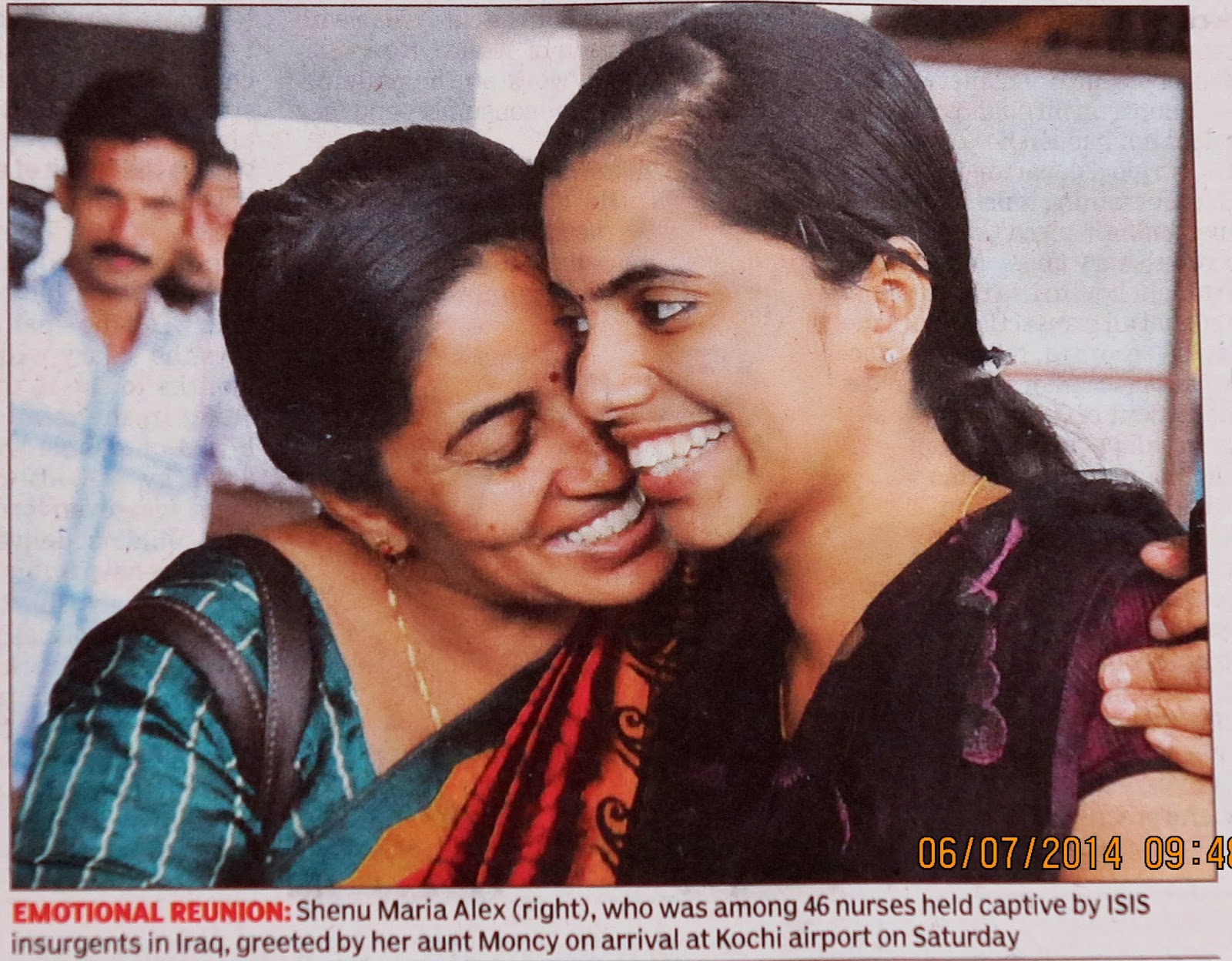
I have been closely following the unfortunate episode of 46 nurses from India working in Iraq, held captives for almost week. The photographs in the news papers of the happy return of all of them brought much relief to all of us.

I listened to the story of an immediate member of the family who was affected by this terrifying experience. Even after two weeks, the fear has not  left them. The conversation is still centred on these things. There are sudden outbursts of crying, screaming and sleeplessness.

Today a family who came to visit for consultation, spoke about the fear that has gripped their seven year old child to go by an auto rickshaw to school, since his friend got thrown off while riding back from the school.

Another mother mentioned about her nine year old daughter refusing to go to the stream for a bath following another girl accidentally falling into the water and needing rescue measures. 

These are examples of acute stress, which sometimes can become a post traumatic stress if the symptoms last for weeks. Usually if the symptoms last for beyond six months, it would call for specific treatment protocol. 

Let me suggest that we audit our stress state by going through the events that have disturbed us. A weekly audit and debriefing with the help of someone is one way of preventing the ill effects of stress upon us! 

Avoid burying our feelings! Our feelings tell the story of our psychologic well being!

M.C.Mathew(text and photo)      

A dog becomes an instructor!


A domesticated dog can do many creative things. I have some previous experiences of dogs being a companion for senior citizens, visually impaired people, children with autism, and functioning as watch dogs. The police, rescue team, crime detectives, etc.  use the dogs for many other purposes.

When I read this report of a family using a dog to help an infant crawl, I was even more interested to recognise the potential of the canines that we are yet to use.

When Anna and I returned after five days of holidays, Daffney, our dog needed a long time to be consoled. She held on to us with both her forelimbs and insisted on being stroked and staying near to us for a long time.

It is important to use the emotional link a dog naturally develops for the further advantages.

Many children are fearful of dogs, which is unfortunate. Most domestic dogs can be trained to develop skills we want them to develop. It is a good practice for children to have contacts with dogs from early in childhood to develop a friendly disposition because dogs offer affection and companionship. I usually encourage families with young children to consider having dogs as a pet!

M.C.Mathew(text and poto)