04 January, 2013

An infant is an emotional being

Every infant (child below one year) who visits me for consultation leaves me surprised by the mystery of early childhood.

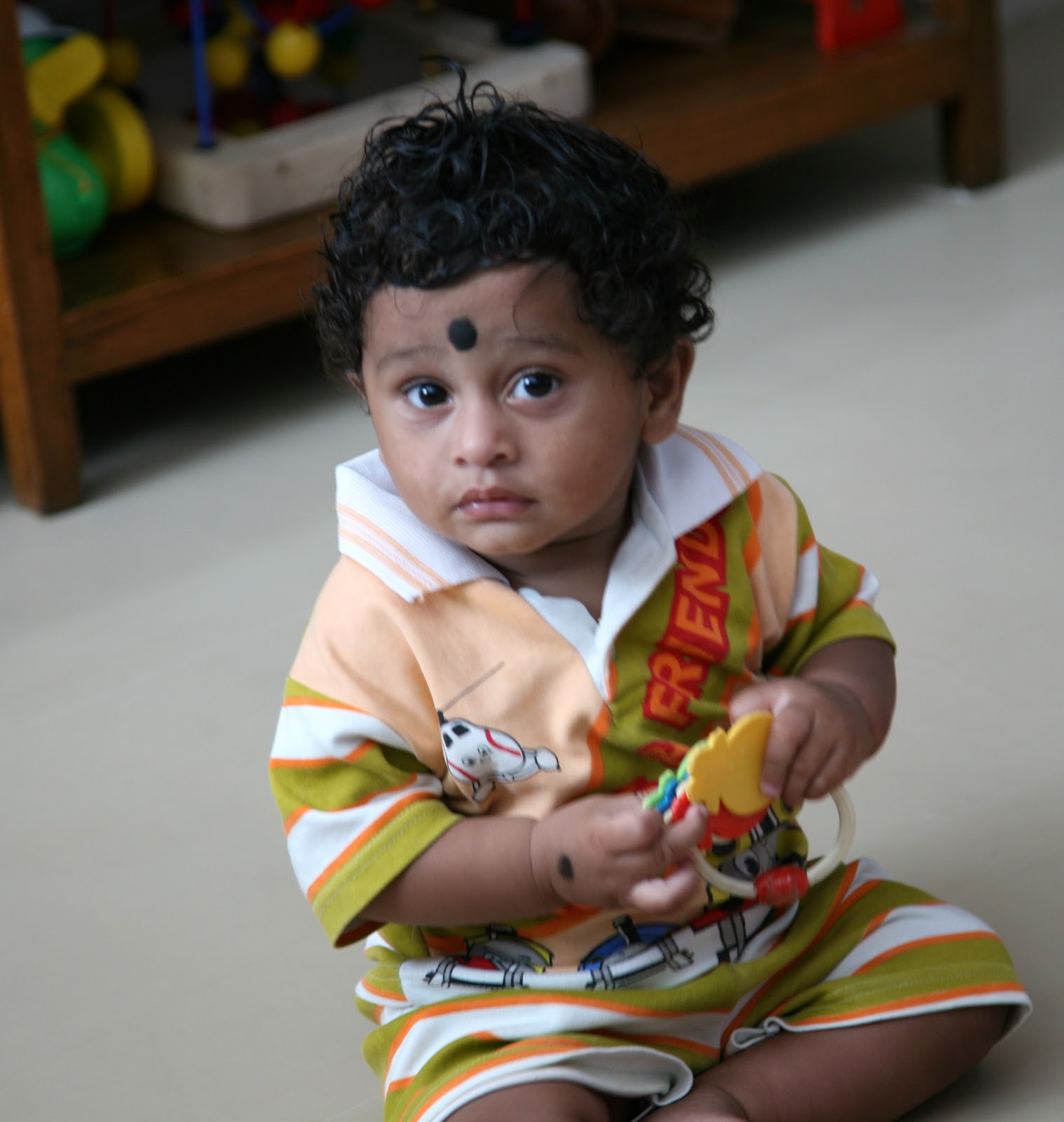
This infant in the photograph is keenly engaged in looking and processing. There is an intensity and curiosity which is explicit on his face. He is attempting to manipulate a toy between his hands, but his attention is elsewhere.

Often people are used to making funny  faces at infants to observe their reaction. Some would stroke or pinch them in the face . Some are in a hurry to carry them. Some would try to wake up the baby if she or he is asleep. There are others who unconsciously frighten the baby by loud laughter or conversations. All these are adult forms of engaging an infant. I am afraid, these are not the ideal ways of approaching an infant.

It is good to pause before an infant giving time and attention for the infant to process the presence of an adult. Three reactions can happen. 

Seeing the presence of a stranger, an infant above the age of four  or five months would cry and turn to the mother to be carried for comfort. If that were to happen, it is good for the adult to wait or avoid any engagement with the infant till he or she returns visual contact.

The second is that the baby is unusually quiet and intently watching the adult initially. The infant may or may not return the smile. Returning a smile is an invitation for the adult to play visually but not to hurry to carry the baby. If the baby were to move the body towards the adult, then alone let the adult offer to carry, that too for a few seconds and return the baby to the mother lest some babies are overcome by strangeness and start crying. 

The third possibility is that a baby from the first instance of contact with the adult exchanges eye contact and takes turns to look. Try playing peek-a-boo and see if the baby is ready for more interactive look and physical proximity. If during the process the infant  reaches out to be carried, please offer to carry. Sometimes even when a baby appears to be visually friendly, the moment you go near to carry, baby may refuse to come to the adult. I wish that adults would honour the desire of the infant and do not insist on carrying the infant. 

Let adults visit an infant knowing that,  the infant may choose to delight or withdraw. It is necessary to respect the fragile and tentative emotional processing of infants. It may be our dress, odour, facial gestures, hair style or voice or  hurried movement to carry that can offset that emotional well being of an infant.

No adult has any right over an infant to carry him or her just because she or he looks cute. Let an infant choose to come to you. Till then stay friendly by reciprocating the eye contact.  Honour the emotional state of an infant. Any trespass of it gives an infant a fearful experience. Let parents recognise this and do let go of the infant till he or she appears comfortable with the adult visitor.

As adults we are under obligation to make every experience of an infant comfortable for him ore her.

M.C.Mathew(text an photo) 

03 January, 2013

Senior house surgency

Of late, doctors when  they complete their under graduate training, choose one of the three options for their future. Apply and get selected for post-gradaute training; join an entrance coaching programme and try for post graduate admission; appear for qualifying examinations to go overseas.

The majority seems to choose one of the first two options. In fact, if the rough estimate is correct, there are thirty five thousand doctors who are undergoing entrance coaching through out the country currently. There will be an equal number who would compete with them for getting a seat for post graduate training in 2013. Only one out of 8 would secure a seat for training as of now.

During my time of training in the early seventies, the post graduate admission was based on the marks obtained in the final examinations. But it was compulsory to have completed one year of senior house sergeancy, out of which six months  in the speciality, one was seeking for post graduate training, before applying for the admission. 

How did the senior house surgency help a doctor in preparing for post graduate training! 

First, it is one occasion after the compulsory rotating internship, when a junior doctor has a chance to  have hands on experience to develop competency in decision making, taking care of patients, being part of a treating team, exercise skills in communication, breaking the news and counselling, acquire clinical observation and examination skills, etc. A senior house surgeon is the first care provider, whose judgement and critical approach determine the treatment outcome. He or she would normally develop managerial skills as he or she is often in charge of one ward of about thirty five patients. It is the house surgeon who presents patients to the consultants on the ward rounds, which would hone his or her skills in clinical communication and self confidence. At the end of one year of my senior house sergeancy, I had done most of the clinical and therapeutic procedures needed in my specialty. Therefore I had the advantage of beginning my post graduate training with an advantage of clinical familiarity.

What a pity that all these are foreign to a junior doctor who gets into post graduate training without this one year of experience! One year post internship clinical training is seminal for completing the undergraduate training soundly. It is during this one year, one becomes a competent primary clinician. 

Let me suggest that all those who would like to have a better completion of their undergraduate training, choose one year of post internship clinical training as a house surgeon. It is even better than one year of training in an entrance coaching centre, in the long run.

If that one year can be spent in a general hospital in a rural area, having good clinical load and reputation of good delivery of services, it is even better for acquiring practical skills. You would have found some role models in the consultants who would naturally become friendly life-long companions! 

M.C.Mathew(text and photo)       

Parenting or caring

I am currently gathering information about the full time availability of one parent at home, till a child joins pre-school at three years of age. Out of 250 families whom I interviewed, only 22 families were able to offer this privilege to children till three years of age.

Something terribly disturbing is emerging form this informal survey. About thirty two percent of  children in the first three years grew up with grand parents, relatives of parents, or one of the parents while the other parent is regularly working elsewhere with only infrequent meetings with the child or care givers, who changed frequently.

Although there are provisions in the corporate sector, in the central government and state government services to get six months to one year of half paid leave for the permanent employees, only two out of fifty six  eligible parents this opted for this  facility.

The first three years are the formative years for social, emotional and behavioural development of children when interaction coupled with value based non formal learning contribute to the conduct and character formation of pre-school children. But in many instances, parents are relatively absent in the lives of their children. However good and caring the substitute parenting may be, there is a void children would grow up with. The qualities of trust, intimacy, affect and playful communication with parents in the early years of a child provide an emotional bonding that binds the children to parents in a loving and affirming relationship.  

I wonder what would become of this generation of pre-school children emotionally, socially and beahviourally when their relationships in the early years have been fragile and tentative! Any deprivation of loving relationships in the early years is known to disturb the children emotionally in the  later years.

I wish parenting of children in the first three years would receive more dedicated attention of parents. Children are the only assets of parents. The rest are only achievements which would fade away with time. Our children are the links in the godly heritage we have inherited. Young children need reverential attention, for God entrusted them to us for their stewardship! They are ours by birth, but God's because they are called into being by God.

All children receive caring. Do all young children receive parenting!

M.C Mathew (text and photo) 

Student and teacher

Anna and I have completed nearly 20 years as teachers in different medical colleges. This has given us a wide expanse of experiences and insights that we treasure.

Let me share three insights.

The medical students are looking for friendships with teachers. They would like to have close contacts with teachers who are open to interaction and listening. Most students would like to know the personal experiences of teachers in the profession for them to get a glimpse of what await them. Teachers communicate better if they are story tellers from their anecdotal experiences. Students take in lot of it and use it to formulate their thoughts and perspectives.

The students look for clarification of values of integrity and honesty, principles of ethics and good practices and a lot about working as an interdisciplinary team. It is through watching the conduct of a teacher at the bed side of a sick person, or while relating to an indifferent student or coping with demands of work that consume enormous time,  the  students would get a preview of how he or she has to get ready for the future. The impressions which students carry with them from the first hand experience of their teachers give them an inner direction to choose their own path. Students are intense in observing and would consider some teachers as their life-long role models. Teachers are more than information providers; they are formators.

The students look up to the teachers to get an overview of the practice of medicine. As they learn their individual subjects they process their learning in a fragmented way. It is the teachers, who can excite the students about the history of medicine and the opportunities which are before them. It is during the training period, most students consider the subjects of their specialty training in the future or locate a place to go to work for long or short term or discover the vocation or calling they sense about their future. The students are often open to be guided, provided teachers engage the students who are ready to make sense about the way they would like to prepare for their future.

I wish students and teachers become co-learners- students finding teachers as their resources and teachers learning from each batch of students about their mid-set and needs.

A medical college setting is a dynamic and stimulating environment.

Anna and I are glad that we have had the best period of our lives well spent in teaching institutions. Students contributed to our formation socially, spiritually and academically.

M.C.Mathew(text and photo)      

02 January, 2013

Act kindly while rendering justice

I recently heard these children sing at a conference an invocation song at the the inaugural function. The theme of the song was love, justice and unity. It was a most appropriate song for a conference which had delegates from about 13 states of India. I wondered why the organisers chose to have an exclusive girl's choir sing this! One of the organizers told me at the tea time, the women represented the theme of love, justice and unity better.

I have been wondering whether we will feel united in our society by anything at all considering that caste, religion, economic status, educational achievements, social class....etc. divide us so badly that people are almost venomous in their approach towards those who differ with them.

I came across what girls of a school have been doing in a rural area about eight kilometres from the school. As an activity of the social service club, these girls visit the senior citizens's home in that village twice a week to help them with their bath, washing, cooking, shopping, visiting, etc. They read newspapers to those who cannot read due to failing sight. They dust and clean the house and premises. They even feed them if they are bed bound. This school has been doing this for over five years now. This village was at the edge of a larger village, and therefore suffered without regular electric supply, which was partly addressed by the initiatives of the school. 

Now, volunteers  from the main village have begun to offer similar help to their neighbours. Another two schools are doing similarly in two other villages.

We need to promote integration and collegiality by several acts of kindness. Our people need to experience inner healing, before they can offer kindness to others. 

Our media is constantly bashing the guilty and accused. There is very little effort to help those who are involved in crime to live and act differently. Accusing a wrong doer is only one aspect of justice; the other aspect of justice is that the wrong doer is redeemed by acts of kindness and personal support, while undergoing punishment. That is how we restore him and enable him or her to live justly and fairly. Every person has a conscience which is subject to revision and renewal. This is why counselling and correctional therapy will be most necessary as a therapeutic component of justice system.

Rendering justice is good jurisprudence; but restoring the offender to fullness of life is healing, which represents the compassionate dimension of justice.

M.C.Mathew(text and photo) 


Honouring women


One of the issues receiving much attention  in the media and the press in India now, is how to regard and relate to women better.

Women are a link between humans because they are potential mothers. A women's roles as wife, mother, grandmother, and the matriarch in  a home  contribute to the stability of a home. A woman is also virtuous in temperament usually, as she is a self giving person by her acts of caring, providing for the household by house keeping and nurturing  children. In fact her own commitment to carry a baby during pregnancy and nurture the baby by breast feeding is a solemn expression of her benevolent nature. A woman adjusts and accommodates to different circumstances with fortitude and grace at home, work place and in society. All women are worthy of honour.

How are we to honour women!    

Jesus of nazareth honured women in many ways. One example was by receiving the hospitality of Martha and Mary and helping them to diffuse the  complaining spirit of Martha by drawing her attention to accept the choice Mary made. Jesus had many women followers, whose ministry of giving and serving Jesus accepted graciously in a male dominated jewish society. Jesus valued women by healing them, talking to them, rescuing them from being victims of the harshness of the 'law'. He projected their worth and virtue.

Let me suggest that we can honour women in different ways. The way we look at them ought to convey our appreciation of their worth and affirmation of their safety and security in our presence. This means that we will not stair at different parts of their body and intimidate them. Their beauty is more internal and external. Therefore looking at their body sensually or seductively is lust, which already is murder, according to the sayings of Jesus of Nazareth.  

All women are equal to men in all aspects. Therefore our girl foetuses, girl children, adolescent girls and adult women are equal in rights, status and opportunities. This is the minimum any civilized civil society can offer to them. When this is denied to them, men ought to consciously facilitate to restore this. 

Women need honour in marital relationship. A husband is called to love his wife self-givingly, according to the teachings of St. Paul. Women in turn respond to this love by giving herself fully to her husband. When both of these happen, they are on a journey to 'become one flesh'. This is a necessary way of honouring women. 

Men ought to be providers and protectors for all women. Let every man be found trustworthy by all women. Let women feel comfortable and peaceful about their modesty because they are safe at all times and at all places because men are their well wishers.

Let the cinema, advertisements, theatre, stories, novels, poetry, music, dance portray women as beautiful beings worthy of respect, and not exposing their bodies to arouse sensual passions. I wish women will be equally responsible in the way they dress to adorn their body and not sensualise their body!

We need to honour women by being deliberately engaged in educating boys and girls of their sacred individual identities to prepare them for an edifying relationships between them. This alone can dispel the current trend of an exploitative attitude men convey toward women.

'Honour women' and that is the means for envisioning a healthy society.

M.C.Mahtew (text and photo)

01 January, 2013

I shall overcome...

I watched this child, who suffers from hearing impairment, partial visual insufficiency, increased muscle tone and convulsions, making efforts to move about in four limbs and reach out to toys to explore. 

She uses her sense of touch, smell and taste to explore her environment. She associates the informations she gathers to make social relationships. She touched me and stayed close to me for a while at the first time she visited me. When she came the second time after three weeks, she greeted me with a sense of familiarity. At home she is able to function almost independently with minimal help. She goes to a special school and integrates into the class room  activity. At seven years of age, she has come to accept her limitations, but is still making efforts to walk, talk and use her residual abilities with determination. 

Her parents told me that, she enjoys playing with her sister and both of them help the mother in cooking. She is keen to take out the vegetables from the refrigerator, wash them and stay in the kitchen to  have conversations with her mother. Her strong sense of smell is to her advantage. She takes care of their dog by feeding, brushing and bathing her. She does all of them easily and dextrously. She lives relationally at home and welcomes visitors by greeting them spontaneously. Her parents find her well adjusted to all situations, while travelling and visiting new places or at the hospital where she gets admitted often for treatment for her convulsions.

Her story is one of overcoming. Her story is a repeat story of Rev.Dr.Martin Luther King, who led the civil rights movement singing the famous inspirational song, 'we shall overcome one day..'

Anna and I receive her story as an inspiration to begin the new year with hope and anticipation. There resides in each of us a call to transform our circumstances. This journey from complaining to overcoming is possible when we can view our difficulties as opportunities. Paul and Silas while being in the prison, used their time to sing and praise God.  

There is another way to live and go through life.  Let our lives lead others to discover this another way in the new year! We send you our good wishes for this year to be blessing in our lives.

M.C.Mathew(text and photo)